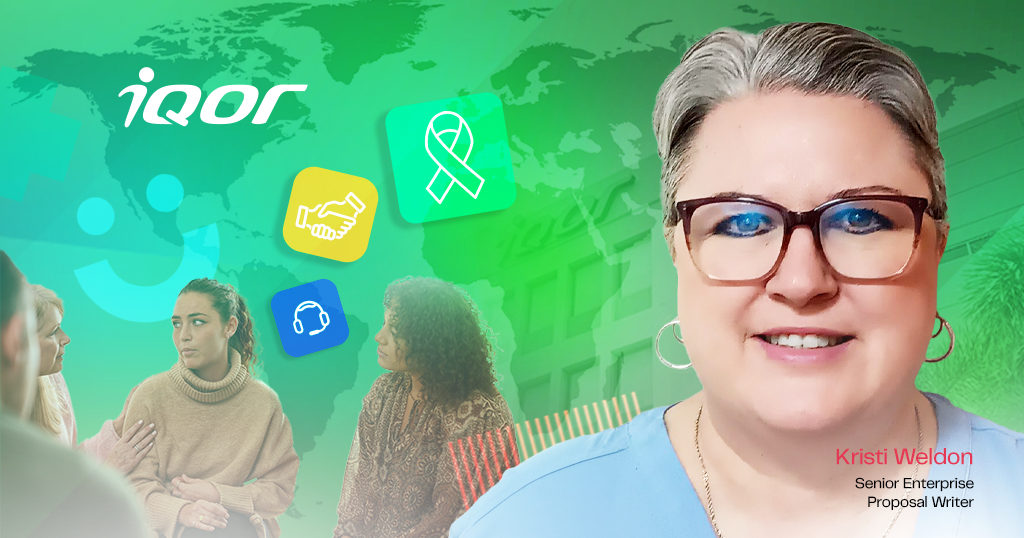
Recognizing World Mental Health Day 2024

How One iQor Employee Faces Mental Health Challenges

As society continues to evolve, so does our awareness and understanding of mental health. In recognition of World Mental Health Day 2024, we at iQor reflect on the importance of mental health in both our personal lives and professional environments. From challenging the stigma surrounding mental health to creating supportive workplaces, advocating for mental well-being is integral to our collective success.  

iQor Senior Enterprise Proposal Writer Kristi Weldon shares her personal mental health journey, providing invaluable insights into the intersection of her mental well-being and her professional life. Her story is one of resilience and advocacy, inspiring all of us to take mental health seriously, both for ourselves and our colleagues. 

Finding Strength in the Struggle

Kristi’s journey with mental health began in her early teenage years when she struggled with depression and suicidal thoughts. At the time, she didn’t have the language to describe her emotions and wasn’t aware that her overwhelming feelings were symptoms of depression.  

Kristi mustered the courage to reach out to her school guidance counselor, but her family’s reaction was less than supportive due to the stigma surrounding poor mental health. Her family’s concern about the social perception of her struggles only reinforced the isolation she felt. 

It wasn’t until years later that Kristi was diagnosed with bipolar disorder at age 32. A turning point in Kristi’s journey came during a hospitalization due to suicidal thoughts. This pivotal moment gave her a deeper understanding of her anxiety and bipolar disorder, and, with the support of healthcare professionals, she learned how to manage her mental health more effectively. 

“Had I not gone through that hospitalization, I would be struggling with something that I don’t have to and that there’s treatment for.”

Overcoming Misconceptions About Mental Health

Kristi has also experienced deep-seated stigmas attached to mental health. Throughout her life, she’s faced situations where people reacted negatively when learning about her diagnosis. She recounts a moment during a writer’s meeting when she mentioned being bipolar. An attendee picked up his chair and moved away from her, treating her as though she had a contagious disease. 

Despite hurtful encounters such as this, Kristi remains committed to breaking down unfair beliefs surrounding mental health. Rather than internalizing these reactions, she views them as a reflection of others’ ignorance, not a judgment of her own worth. Through her openness, Kristi aims to show that mental health challenges are nothing to be ashamed of and that seeking help is a sign of strength, not weakness.

“Anyone at any given time can have a mental health challenge.”

You Are Not Alone

Kristi emphasizes the importance of building a supportive network to mitigate feelings of loneliness. Building connections with others — whether through personal relationships or professional support systems — can make a significant difference for individuals dealing with mental health issues. 

The Importance of a Supportive Workplace Environment  

When Kristi first joined iQor in 2021, she kept her mental health struggles private. For the first year and a half, no one knew about her mental health challenges. She was hesitant to disclose this due to negative experiences in past workplaces where she had been “burned” before.  

However, as she settled in, she recognized the importance of fostering a safe and supportive workplace. Kristi says that when employees feel comfortable disclosing their mental health challenges, they are happier and more productive.  

Leaders play a critical role in this. Kristi’s boss created an open and supportive environment that empowered her to seek help and feel comfortable at work. Kristi’s advice to leaders is clear: recognize that employees may be struggling with undiagnosed mental health issues and cultivate a workplace where they feel safe to seek help and receive the support they need.

“I’m very fortunate to have a wonderful boss who’s been very supportive of me and has allowed me to be open and communicative about my issues.”

The Role of Professional Support and Employee Assistance Programs 

Professional support systems, such as employee assistance programs (EAPs), are invaluable for employees navigating mental health challenges. Kristi credits her diagnosis and subsequent mental health management to the support she received through her employer’s EAP, which provided her with access to specialists and essential resources. EAPs play a critical role in helping employees manage mental health by offering short-term counseling and referrals for long-term care.  

“It was a counselor through work that actually got me help and got me diagnosed initially,” Kristi shares, highlighting how crucial these programs can be in providing employees with access to life-changing resources. 

Moreover, Kristi underscores the importance of seeking specialized mental health professionals. For her, psychiatric specialists provided the expertise needed to tailor her treatment effectively. Following the guidance of healthcare professionals is key to successfully managing mental health. 

Balancing Career and Mental Health

For Kristi, balancing a demanding career with mental health challenges has been a journey of self-awareness and adaptability. One of the key lessons she’s learned is the importance of finding a role that aligns with your strengths and preferences. Kristi thrives in a high-stress, fast-paced environment, describing her work style as similar to that of a sprinter — handling short bursts of intensity. She acknowledges that this approach isn’t for everyone: “Figure out what you like, what you’re good at, and what you enjoy, and start from there to build your career while balancing your mental health.” 

Another important aspect of maintaining this balance is setting boundaries and incorporating mental health needs into your daily routine. Kristi explains that if you require time for self-care, such as journaling or therapy, finding a job with flexible hours can make all the difference. “Build balancing your mental health into your career,” she encourages, stressing the importance of crafting a professional life that supports rather than hinders your well-being. 

By setting realistic expectations and learning when to step back, she’s been able to create a healthier, more sustainable work-life balance. Her story highlights that success in both career and mental health requires ongoing self-awareness, flexibility, and the courage to prioritize your well-being. 

Kristi’s Strategies and Coping Mechanisms

In addition to professional support, Kristi has developed a range of strategies to help manage her mental health. She finds solace in daily practices like journaling and meditation, which allow her to process her emotions and stay centered. Music is also a vital part of her routine, and she often turns to her favorite band, Shinedown, whose songs frequently explore themes of mental health. “They’ve been singing about mental health for 20 years,” Kristi explains, underscoring how their music has become a grounding force that helps her navigate difficult moments. 

Visualization exercises, which are mindfulness techniques in which individuals create vivid images in their minds, are another tool Kristi uses to stay focused and maintain emotional balance. These techniques and her dedication to self-care help her manage the challenges of a high-pressure job while maintaining her well-being. 

When it comes to handling negative reactions to her mental health, Kristi’s approach is both empowering and pragmatic. Rather than engaging in conflict, she chooses to let others’ reactions reflect their own ignorance, not her worth. “The only thing I can control is me,” she says, highlighting the importance of self-awareness in managing both internal struggles and external perceptions. Her calm and composed mindset allows her to protect her peace while educating others about mental health through her actions. 

Kristi’s Career Journey and Message to iQor Employees

Kristi’s career path is a testament to her resilience and determination. With roles ranging from sales to teaching to her current position as a senior enterprise proposal writer at iQor, Kristi’s professional journey is marked by significant achievements. Her credentials — including a CF-APMP certification through the Association of Proposal Management Professionals (APMP) — and her leadership role as iQor’s Loopio Champion for Loopio proposal management software highlight her dedication to her work.      

To her colleagues at iQor and beyond, Kristi’s message is one of hope and solidarity. She encourages employees to utilize the mental health resources available through the company’s benefits and to seek support when needed. Understanding the varied perceptions of mental health across different regions across the globe is also crucial in fostering an inclusive and supportive work environment.   

At iQor, supporting mental health is an integral part of fostering a diverse, equitable, and inclusive workplace. As Kristi’s story illustrates, mental health challenges can impact anyone, and creating an environment where employees feel safe to seek support is essential. iQor’s commitment to diversity, equity, and inclusion (DEI) extends beyond recognizing differences — it involves actively providing resources and creating spaces where all employees can thrive, both personally and professionally. 

iQor encourages every team member to embrace their unique journey. Together, we can continue to break down barriers, reduce stigma, and ensure that everyone feels valued and supported. 


Kristi Weldon is a senior enterprise proposal writer at iQor who advocates for mental health resources and well-being. She is also the leadership cohort and chair for the APMP Mental Health Affinity Group. Connect with Kristi on LinkedIn to discover more about her mission to strengthen mental health awareness in the workplace. 

At iQor, creating a safe space for employees to seek support is essential. If you or someone you know is facing a mental health crisis, please download our list of available helplines for suicide prevention and mental health resources across the countries where we operate.  

 

How Machine Learning Can Help You Reduce Frontline Employee Attrition

Leveraging Machine Learning to Predict Employee Attrition Risks and Guide Retention Interventions  

How Machine Learning Can Help You Reduce Employee Turnover is a free webinar available on demand, presented by iQor’s Vice President of Operations Terri Robertson, Senior Vice President of IT Joe Przybylowski, and Data Scientist Andrew Reilly. Here’s an overview of what they discussed.  

Why Retention Strategies Are Critical to Your Business Success 

Employee attrition is a more pressing concern for organizations than ever, as evidenced by cultural dialogue like “The Great Resignation” and “quiet quitting.” Attrition is even more significant for BPOs like iQor whose business is to deliver outsourced customer service to the brands that entrust us. 

The cost of employee attrition is significant in both direct and indirect ways. For example: 

  • The average cost to hire and train a replacement employee can be up to 200% of that employee’s salary
  • Replacing an experienced employee with a new hire can lead to a decrease in productivity and efficiency, which can affect revenue. 
  • A high turnover rate can lead to discontinuity in customer service, which can result in loss of business. 
  • High turnover can impact morale among other employees and cause a snowball effect of attrition, incurring further costs.  

The value of investing in employees speaks for itself. At iQor, employee experience is a cornerstone of our business model. Creating a work environment that promotes job satisfaction, recognition, and growth opportunities is critical to retaining valuable tenured employees. Optimize the customer experience through human-centric interaction with agents.

Using Predictive Analytics to Help Prevent Attrition With Proactive Retention Strategies at iQor 

For over 15 years, iQor has used cutting-edge technology to provide an irresistible employee and customer experience (CX). Our team of expert data scientists has developed models for predictive analytics to guide our strategies for revenue recovery, customer satisfaction (CSAT), net promoter scores (NPS), and more. So, why not leverage our data analytics expertise to predict attrition before it has a chance to materialize?

Using the power of predictive analytics, we asked the fundamental question of attrition: How do you know when an employee is thinking about leaving?

To answer this question, our team of expert data scientists developed a machine learning model to identify variables that correlate with attrition and predict which employees might be at risk of leaving the company. Our goal was to play offense rather than defense to the problem of employee attrition by developing proactive retention strategies for at-risk employees. The model successfully:  

  • Analyzes which variables influence employee attrition. 
  • Identifies employees at risk of attrition. 
  • Guides our operations team’s retention strategies. 
  • Contributes to the retention of thousands of at-risk employees. 
  • Informs an improved employee experience through a culture of empathy and professional development opportunities

Using the power of predictive analytics, we asked the fundamental question of attrition: How do you know when an employee is thinking about leaving?

Customized Employee Retention Processes Guided by Predictive Analytics 

Predictive analytics placed the ball in our court to proactively shape a positive employee experience that improves retention. The foundation of machine learning and predictive analytics is data. To begin, iQor’s data scientists needed to know what data they required to build their “crystal ball” for proactive employee attrition prediction. 

Their approach to data modeling consists of three stages: 

1. What data is available?  

The existing body of structured data could include tenure, compensation and benefits, workforce management data, interaction analytics, coaching outcomes, performance reviews, bonus history, training data, and other information that iQor already gathered about our employees.  

2. What are we missing?  

After conducting an inventory of existing data, we could identify data gaps. Gaps often include unstructured data, which is more difficult to gather and too subjective to easily evaluate, such as employee feedback.  

3. What can we create?  

Identification of data gaps can then drive strategies for gathering that data. For example, annual surveys for employee feedback are an option, but that doesn’t provide enough data for accurate analytics. Filling in this gap requires a high-frequency method of employee surveying for gathering reliable and timely feedback regarding their outlook on the job.  

The answers to these questions create a broader data pool of structured and unstructured data to begin identifying which data points correlate to attrition risks. 

Transforming Raw Data Into Usable Variables  

Data is just raw material; it needs to be refined to be useful, as described by Gartner’s Four Phase Data Maturity Model. iQor’s data scientists had to decide how to categorize the data into variables that could be computed by their algorithms. They then validated each data feature using a process called variable importance testing to determine what to include and exclude from the production model. This process assesses how much influence a particular variable or feature has historically impacted our attrition. Those that rank high are selected while those that rank low are rejected. 

Using these variables and a combination of five main algorithms, our data scientists deployed a five-fold cross-validated Stacked Ensemble Meta learner with auto-tuned hyperparameters—or, in layman’s terms, they created a customized employee retention model that could assess the probability of employee attrition within the next 60 days. 

From Data Science to Pragmatic Action: The Plan for Proactive Frontline Employee Retention 

At iQor, we place a high value on providing exceptional employee experiences. As our data scientists and operations teams collaborated to develop a practical, specific, repeatable process for proactive retention, they kept the employee experience top of mind. The process needed to be simple for employees and managers in terms of time and effort expended; it needed to be standardized yet flexible; and it needed to be embeddable into our feedback culture. The result was a Measurable Skip-Level Meeting, also known as “The Touch Base.” 

“The Touch Base” Strategy for Employee Retention  

Every week, iQor runs our machine learning model for all 40,000 employees company-wide. We analyze each individual’s probability of attrition between 0% and 100%. At-risk employees are identified at a threshold of 65%. Employees who meet or exceed this threshold for attrition risks will automatically engage the company’s proactive retention strategy enacted by the operations teams. 

As a result of these analytics, our operations teams are informed of at-risk employees every week. They receive the employees’ names, the names of their direct supervisors, and the skip-level managers responsible for scheduling the Touch Base. These managers have a structured guide with clear, consistent guidelines, a system of record, and a method for feeding results back into the analytics model. 

The Touch Base is standardized enough to provide data points that can guide improvements to the machine learning model but also conversational and customized to each employee’s needs.  

It’s important to note that the Touch Base is not focused on the employee’s performance. Rather, it is about encouraging open communication to identify and support the employee’s needs. The anatomy of the Touch Base is as follows:  

  • Before the Touch Base 
    • The manager reviews the employee’s information to approach the conversation with an informed and empathetic mindset. 
    • The manager schedules the 30-minute session with the employee through our workforce management system.  
  • During the Touch Base 
    • The manager asks open-ended questions in an effort to identify what the employee may be experiencing that makes them at risk.  
    • The manager lets the employee guide the conversation to help the employee feel listened to, valued, and supported.  
    • The manager thanks the employee for their time and willingness to share. 
  • After the Touch Base 
    • We use the same module that guides our coaching to measure the effectiveness of each Touch Base. The Touch Base checklist includes a summary with the following priorities: 
      • Clarify timelines, deliverables, and expected outcomes. 
      • Agree on next steps. 
      • Schedule a follow-up meeting with the employee. 
      • Escalate to the next level of management, if needed. 
    • Lastly, the manager documents the meeting in the system with as many details as possible. 

The manager also rates the Touch Base for their impression of the employee’s overall state of being. In some cases, just having the conversation with the manager can make the employee feel valued and clear up the risk of attrition. In other cases, the situation is not something the manager can easily address, and escalation may be necessary.  

Combining Clinical Trial Methodology and Human Storytelling to Gauge the Effectiveness of the Touch Base Process and Guide Next Steps 

For iQor’s machine learning model to be effective, it has to be able to measure the effectiveness of our interventions and the results of these Touch Base meetings. We performed a controlled study, much like a clinical trial, to go beyond the manager ratings to use a scientific approach to our evaluations.  

Comparing Retention Outcomes Between Control and Experimental Groups Showed a 2.6x Increase in Retention for Touch Base Employees 

Out of 100 at-risk agents, we withheld a small sample of at-risk agents to serve as a control group. They received no Touch Base interventions. The other 95% served as the experimental group and proceeded through our Touch Base intervention process. The results were clear. After 60 days, the control group experienced 18.3% attrition while the experimental group experienced 7% attrition.  

This led to two main findings:  

  1. The model appropriately identifies employees at risk of attrition. 
  1. The intervention is meaningful.  

At-risk employees who go through the Touch Base process are 2.6 times more likely to stay with the company than employees who do not receive proactive retention strategies. We refer to this as our Attrition Mitigation Factor. The takeaway? Our Touch Base strategy worked to effectively retain at-risk employees and embody our commitment to providing an outstanding employee experience.

Attrition Mitigation Factor, How Machine Learning Can Help You Reduce Employee Turnover

Stories Shared by Agents and Managers Through a Culture of Feedback Relate Positive Outcomes Beyond the Science 

What steps actually work to retain at-risk employees? The answer to this can help us implement a repeatable process and create a culture of feedback. Feedback and storylines from our operations teams about their experiences with the Touch Base process guides continuous improvement to the model.  

Using the Touch Base process, managers now get to talk directly to frontline employees instead of just hearing from their direct managers. This makes it much easier to find resolutions and improve relationships to encourage retention. When managers listen, they can facilitate adjustments that lead to employee retention. Sometimes, preventing employee attrition is as simple as adjusting schedules. 

Putting the “Active” in “Proactive:” How the Machine Learning Model Constantly Self-Improves 

iQor’s machine learning model is dynamic. Future improvements are guided by the data science team, the operations team, and stakeholders, who have the opportunity to provide feedback and ask questions during quarterly reviews. The key is data. Each time the machine learning model processes new information, it improves its own ability to fulfill its intended purpose.  

Best Practices for a Machine Learning Approach to a Proactive Retention Strategy 

iQor’s machine learning model is successful because our data science, operations, and frontline teams collaborated to define, implement, and improve the process. Embodying our iQorian Value of open communication helped our teams develop an effective machine learning model that kept the human experience at the forefront of the process. 

Here are some best practices our teams followed: 

  • Define the problem in as much detail as possible through collaboration, data discovery, and analysis.  
  • Acquire high-quality data by asking three main questions: what data do we have, what data can we create, and what data can we enrich by joining it to another data source? 
  • Name the project to give it its own brand. Our Touch Base system makes the project memorable to stakeholders and builds value.  
  • Create a control group like a clinical trial to evaluate results for an accurate indication of effectiveness.  
  • List all KPIs to specifically define the model’s parameters.  
  • Start with a quick win to motivate involvement and maximize collaboration potential.  
  • Fail small and fast to allow the data science methodology to break the project into bite-sized pieces that are not overwhelming.  
  • Communicate between teams so they can seek support across the organization. Establishing a regular cadence for communication keeps channels open that we can use as potential input sources for continually improving the model. 

Investing in Employees to Retain Tenured, High-Performing Teams 

Employee attrition can be a significant issue for any company. Our proactive retention strategies help us stay ahead of the curve through processes that incentivize valuable employees to stay on board. iQor’s machine learning model successfully predicts attrition and guides effective intervention strategies, empowering us to transform at-risk employees into tenured career professionals that provide irresistible customer service.  

Experience the Best in CX  

iQor offers analytics as a service to enhance employee, customer, and client outcomes. Our proprietary speech analytics platform, cloud computing, machine learning, artificial intelligence, and data analysis enable us to provide effective workforce management solutions, flexible work environments, and improved coaching processes. We prioritize our employee experience and aim to cultivate a culture of success that fosters loyalty and high performance. 

As a managed services provider of customer engagement and technology-enabled business process outsourcing (BPO) solutions, iQor provides a comprehensive suite of full-service and self-service scalable offerings that are purpose-built to deliver enterprise-quality CX.  

Our award-winning CX services include:  

  • A global presence with 40+ contact centers across 10 countries.  
  • A CX private cloud that maximizes performance and scales rapidly across multiple geographies on short notice.  
  • A partnership approach where we deploy agents and C-level executives to help maximize your ROI.  
  • The perfect blend of intelligent automation for scale and performance coupled with an irresistible culture comprised of people who love to delight your customers.  
  • Virtual and hybrid customer support options to connect with customers seamlessly, when and where they want.  
  • The ability to launch a customer support program quickly, even when you need thousands of agents ready to support your customers.  
  • A best-in-class workforce management team and supporting technology to create a centralized organization that can better serve your entire business.  

iQor helps brands deliver the world’s most sought-after customer experiences. Interested in learning more about the iQor difference? If you’re ready to start a conversation with a customer experience expert, contact us to learn about how we can help you create more smiles. Heart

Joe Przybylowski is senior vice president of IT at iQor. Connect with him on LinkedIn.
Andrew Reilly is a data scientist at iQor. Connect with him on LinkedIn.
Terri Robertson is vice president of operations at iQor. Connect with her on LinkedIn.

How to Use Machine Learning to Power Conversations and Retain More Contact Center Employees

Improve the Employee Experience for Customer Service Agents and Supervisors Through Conversations Informed by Predictive Analytics   

Creating rewarding employee experiences and retaining employees is key to running any business. Using machine learning as a retention enabler is the focus of this blog post. 

While appearing on CNBC in 2019 to announce a new tool IBM had created—with AI, machine learning, and predictive analytics—to identify employee flight risk candidates, former IBM CEO Ginni Rometty said, “The best time to get to an employee is before they go.”  

By harnessing digital technology innovation, forward-thinking business process outsourcers (BPOs) can take action to reduce employee churn—especially among frontline workers.  

In this blog post, we’ll explore how BPOs can use machine learning and predictive analytics to retain more contact center employees by assessing frontline employee attrition risk and leveraging that knowledge to create an employee experience that often addresses their unique needs.  

We’ll cover: 

  • Employee retention in the 2020s. 
  • Costs of replacing contact center employees who leave. 
  • Modeling data to identify employee attrition risk patterns. 
  • Predicting and reporting employee attrition risks. 
  • Intervening to retain employees. 
  • Measuring intervention outcomes. 
  • Calculating the impact of intervention on P&L. 
  • A real-world example.

Employee Retention in the 2020s  

Since the onset of the pandemic, employee retention has become an even greater challenge than it was when Ginni Rometty appeared on CNBC in 2019.  

A global survey by PwC revealed that, across all lines of work, one in five employees expected to find a new opportunity in 2022.  

Digitally savvy BPOs use every tool at their disposal in an attempt to retain their frontline customer experience team members. 

Costs of Replacing Contact Center Employees Who Leave  

Direct and indirect costs add up quickly when replacing contact center employees who leave voluntarily. 

Direct costs include recruiting, onboarding, and training each new employee. It can take months to hire a new employee and train them to become fully versed in a new customer experience position. 

Indirect costs become factors the moment an employee departs. That’s when the employer loses the employee’s skillset, everything the employee learned about the company and the CX program they supported, as well as internal processes when working with their team and stakeholders.  

Moreover, teams have to cover the gap left by the departing employee until a new employee is onboarded and up to speed.  

When a team member departs, their loss can also lower morale. When an experienced worker leaves—especially one in a supervisory role—indirect costs rise even higher.

Watch Our Webinar

iQor SVP IT Joe Przybylowski, Data Scientist Andrew Reilly, and VP Operations Terri Robertson explain how iQor uses machine learning to help reduce employee turnover.  

Modeling Data to Identify Employee Attrition Risk Patterns

Organizations have long used annual surveys to measure employee sentiment. Surveys can provide a limited sense of how employees feel about working for an organization to help guide general improvements. Annual surveys are limited in their ability to identify individual employee sentiment and predict which specific employees are likely to leave, for several reasons: 

  • Many workers don’t complete the survey. 
  • Some workers might respond with what they think is the “right” answer instead of how they really feel. 
  • Some organizations only use anonymous surveys, so the organization doesn’t know which employees fit the profile of a flight risk. 

For a more accurate snapshot of individual employee sentiment, quick surveys conducted at regular intervals that identify employees are often more effective.  

Training the Machine Learning Model 

Data Scientists can use machine learning to analyze harvested data from former employees’ surveys and create profiles of employee sentiment that suggest when a worker is likely to voluntarily separate from the BPO. With these profiles, data scientists can create an employee attrition risk training model for a machine learning algorithm. As new data is compiled from existing workers and as more workers depart, machine learning automatically updates the algorithm to make it more accurate. 

Adding More Data Sources for Modeling Accuracy 

While using a single source of data may provide some guidance, there’s always a risk that the model is biased in some way, or that the sample size is too small. Using multiple data sources makes the model more accurate.  

Data scientists follow a formal process to identify and validate potential data sources based on elements of a worker’s environment, including how they interact with coworkers and supervisors. 

Environmental data sources might include: 

  • Schedule. 
  • Login and logout times. 
  • Frequency of breaks. 
  • Compensation. 
  • Complexity of the tasks assigned. 
  • Coaching interactions. 

Data scientists diligently explore other data sources through cross-functional analysis of processes.  

Predicting and Reporting Employee Attrition Risks 

Using multiple data sources minimizes bias built into a single data source. With enough data, predictive analytics (a subset of machine learning) can forecast which employees are the most likely flight risks and why they are at risk of leaving. 

Once data analysts have an accurate view of which employees are likely to voluntarily separate—and the probable causes for their separations—they share their findings with the employees’ managers. These reports get to the heart of who’s at risk and why, and spare managers the tedious task of having to decipher the data.  

The manager then determines the next step to take with each employee. Knowing the likely reasons an employee is an attrition risk gives managers a relevant starting point when they intervene proactively in their attempt to retain the employee. 

Intervening to Retain Employees 

Knowing why an employee is considering leaving can enable a manager to determine the best approach to resolve the employee’s concern, create a better experience for them, and help them remain on the team. 

When the manager is empowered to take an empathetic approach to intervening with the employee, they help the employee understand their commitment to resolving the concern. 

For example, if predictive analytics identifies an employee encountering scheduling concerns that make their job logistically challenging, the manager can work with the employee to design a more flexible schedule that better meets the employee’s needs. 

If, for instance, predictive analytics identifies an employee seeking additional career growth opportunities, the manager and employee can develop a plan to support the employee’s aspirations to learn and grow within the organization. 

With these and many other examples, when a manager knows the likely reasons an employee might voluntarily separate, they can tailor their approach to address the employee’s individual needs and create a better employee experience that recognizes their value to the organization and keeps them on the team.

More Real-World Examples

Learn How Machine Learning Can Help You Reduce Employee Turnover
Check out our webinar featuring iQor SVP IT Joe Przybylowski, iQor Data Scientist Andrew Reilly, and iQor VP Operations Terri Roberts to discover how to harness technology to engage employees and reduce turnover. Get the details directly from the experts responsible for this program. 
Watch Now

Measuring Intervention Effectiveness 

To determine the efficacy of interventions, companies run tests. Among a group of employee churn candidates, a portion is placed in a control group to measure the differences in outcomes between those who receive interventions and those who don’t.   

Calculations over time have proven how much more effective intervening is than not intervening to retain employees predicted to be at risk of voluntarily separating through the intelligent model explained in this blog post. This can result in significant boosts in contact center employee retention as well as improved overall employee experiences, including career advancement for retained employees.  

Bottom Line: Retaining Customer Experience Agents Improves CX 

Experienced customer service agents build relationships with their teammates, serve as mentors to newer agents, treat their customers with the care and respect they deserve, and champion the brand they represent. 

With machine learning and predictive analytics, BPOs can positively affect frontline employee retention and keep their employees and customers smiling. Heart

Experience the Best in Data Analytics  

iQor’s analytics as a service offering uses a combination of iQor’s proprietary speech analytics platform, cloud computing, machine learning, artificial intelligence, and data analysis to develop custom interventions for identified areas in need of improvement along the customer journey. The results produce targeted improvements for the employee, customer, and client. 

iQor is a business process outsourcing company ideally suited to help brands create amazing customer experiences. iQor provides a comprehensive suite of full-service and self-service scalable offerings that are purpose-built to deliver enterprise-quality CX. 

Our award-winning CX services include:   

  • A global presence with 40+ contact centers across 10 countries.   
  • A CX private cloud that maximizes performance and scales rapidly across multiple geographies on short notice.   
  • A partnership approach where we deploy agents and C-level executives to help maximize your ROI.   
  • The perfect blend of intelligent automation for scale and performance coupled with an irresistible culture comprised of people who love to delight your customers.   
  • Virtual and hybrid customer support options to connect with customers seamlessly, when and where they want.   
  • The ability to launch a customer support program quickly, even when you need thousands of agents ready to support your customers.   
  • A best-in-class workforce management team and supporting technology to create a centralized organization that can better serve your entire business. 

iQor helps brands deliver the world’s most sought-after customer experiences. Interested in learning more about the iQor difference? If you’re ready to start a conversation with a customer experience expert, contact us to learn about how we can help you create more smiles.   

Joe Przybylowski is SVP of IT at iQor. Connect with Joe on LinkedIn.
Andrew Reilly is a data scientist on the AI & Data Science Team at iQor. Connect with Andrew on LinkedIn.

5 Steps to Improve Coaching Effectiveness for Frontline Supervisors

Delivering Effective Coaching That Strengthens Performance in an Increasingly Complex CX Ecosystem 

5 Steps to Improve Coaching Effectiveness for Frontline Supervisors is a free webinar available on demand, presented by iQor and AmplifAI. David Arellano, head of product at AmplifAI, joined the authors of this blog post: Saurabh Bhaskar, iQor’s senior vice president of operations, and Anthony Paige, director of training and quality for iQor. Here’s an overview of what they discussed.

Measuring and Improving Frontline Coaching Effectiveness Is Critical 

Eighty percent of agents who leave contact centers do so because of their frontline supervisor. And the biggest challenge these supervisors face is usually their own interpersonal coaching skills. Effective frontline coaching is the best way to sustain and improve agent performance. This means measuring and improving frontline coaching effectiveness is critical to achieving desired outcomes. 

iQor invests heavily in recruiting, training, and coaching frontline employees. We want everyone we hire to enjoy a long and successful career with us. That’s why we provide professional learning opportunities and pathways to advancement. Coaching has always been a priority. 

Automation Has Changed Agents’ Roles 

In recent years, automation has taken on many of the more mundane tasks that agents used to perform, leaving them to handle more high-skill and high-value tasks.  

The growth of multi-channel and omnichannel customer experience—and all the digital CX technologies that make them possible—has enabled that complexity. Every CX interaction is recorded. Proprietary data analytics technologies scour recordings in search of opportunities for improvement through coaching and examples of best practices in action.  

Contact Center Complexity and Data Overload Create New Coaching Challenges 

Several years ago, the increasing complexity of the agent ecosystem began to leave supervisors wondering what their next coaching step should be. There was so much data and no efficient, effective, and accurate way to make sure coaching aligned with business priorities or measured coaching effectiveness. 

Fifty-six percent of contact center employees say job complexity is a top challenge. 

One Solution to Reduce Complexity, Identify Business-Critical Coaching Opportunities, and Measure Coaching Effectiveness 

We wanted to allow our supervisors to spend less time with data and more time coaching, so we researched numerous potential solutions.  

We invested in: AmplifAI, an AI-driven performance enablement platform that:  

  • Facilitates coaching events by surfacing the most impactful coaching opportunities. 
  • Reduces complexity by telling supervisors what they need to do next (based on specific coaching goals). 
  • Reports on agent performance in key areas. 
  • Identifies the type of coaching that agents and coaches need.  
  • Measures coaching effectiveness. 

How Webinar Attendees Rate Their Coaching Effectiveness of Frontline Employees 

14% 43% 14% 4% 25% 
Excellent Good Fair Poor Not Measuring 

Three years later, results from our strong partnership with AmplifAI—and the solution’s sophisticated AI and machine learning—have proved that investing in AmplifAI was the right decision.  

iQor employs AmplifAI to help coaches coach and measure coaching effectiveness. The five steps to improve coaching effectiveness show you how we work together. 

1. Create and Communicate Your Coaching System 

Your coaching system—the technology that facilitates the coaching process and measures coaching effectiveness—can only be as good as the coaching itself. 

iQor and AmplifAI align on what good coaching looks like: 

  • Proactive coaching with a specific goal in mind that enables the agent to perform their job better. 
  • Frontline leaders customize coaching to the individual agent’s learning style, whether that’s visual, audio, kinetic, or digital. 
  • Even in flexible work environments where agents can work at home or on premise, all agents are trained equally well.  
  • Supervisors need to be able to focus on their team, not the data, and provide specific actions the agent can deliver. 
  • Quick onboarding, consistent training, and effective coaching contribute to improved retention. 
  • Better employee experience translates to improved customer experience. 

To create your coaching system, you’ll also need clear expectations about:  

  • What the system can and will do for you. 
  • How much you’ll use the system for coaching. 
  • Methods you’ll use to facilitate coaching events. 
  • KPIs that are most important to the business. 
  • What constitutes coaching success. 

For iQor, the system provides easy-to-review performance data that show where everyone stands in relation to their goals, their team, and their program. 

2. Train Coaches How to Communicate and Develop Others 

In contact centers, supervisors are often former agents who were promoted from within.  

All agents need to be able to communicate effectively. Those who become supervisors (and coach others) also need to have the right underlying skillset, which includes the ability to help others change their behavior.  

At iQor, developing a new leader includes providing best practices for follow-through and leadership skills training. Plus, new leaders are trained to leverage technology that will help them be effective coaches. 

3. Provide Visibility Into Performance and Testing 

With AmplifAI, the system’s AI can be trained to identify coaching opportunities with the greatest potential impact and direct coaching activities to the right metrics, individuals, and tactics to add the greatest lift to performance.  

The AI cuts right through the complexity to show supervisors what they need to do next, offering coaching suggestions unique to each agent’s individual needs. This enables supervisors to save time they once spent determining which potential coaching opportunities to pursue—up to 40% of their time—and devote that time to coaching.

The AI cuts right through the complexity to show supervisors what they need to do next, offering coaching suggestions unique to each agent’s individual needs. This enables supervisors to save time they once spent determining which potential coaching opportunities to pursue—up to 40% of their time—and devote that time to coaching.  

Should KPIs change—along with the behaviors required to achieve success with those KPIs—the system can be tuned to reflect which coaching opportunities are important. iQor’s close working relationship with AmplifAI makes those kinds of changes easy to make. 

4. Measure Coaching Effectiveness 

Measuring coaching effectiveness is critical to understanding which coaches are doing exceptionally well and deserve recognition, and those who could benefit from coaching. 

5. Learn From Successful Coaches 

Many coaches are good at walking their agents through processes and expectations. Some are good at helping agents buy into and become a part of the learning and development process. Others are great at helping the agent understand how this change will benefit them. 

By measuring coaching effectiveness, you can identify where individual coaches could benefit most from coaching. 

AmplifAI points to the most successful coaching lessons in a given area. That enables other coaches to learn how to modify their own behavior based on how the most successful coaches teach those lessons. Also, coaches can use those lessons when coaching agents. 

The best coaching helps improve outcomes for agents, keeps agents more engaged, and contributes to their long-term success. 

The Proof Is in the Results 

When a telecom client asked iQor to shift their KPI emphasis from customer satisfaction (CSAT) to net promoter score (NPS), we turned to AmplfAI to identify opportunities to coach the behaviors needed to improve NPS. By focusing on the metrics that matter most, AmplifAI reduced the number of dashboards and reports that coaches were required to review. 

With a significant increase in coaching and more time spent on effective agent development, we produced these results for the client: 

  • 6x improvement in customer resolution time. 
  • An increase in NPS ranging from 2.5% at the beginning of the test period to an increase of 13% at the end of the test period. 
  • 40% more coaching sessions with tracking and accountability. 

Your Next Step 

For the complete case study details, plus charts, graphs, more in-depth discussion of the points referenced here, and an easy-to-understand look at how AmplifAI works, watch the webinar. It’s free and available on demand. 

Experience the Best in CX 

We partner with clients to design the optimal mix of CX automation and people. iQor is ideally suited to help brands create amazing customer experiences. As a managed services provider of customer engagement and technology-enabled business process outsourcing (BPO) solutions, iQor provides a comprehensive suite of full-service and self-service scalable offerings that are purpose-built to deliver enterprise-quality CX. 

Our award-winning CX services include: 

  • A global presence with 40+ contact centers across 10 countries. 
  • A CX private cloud that maximizes performance and scales rapidly across multiple geographies on short notice. 
  • A partnership approach where we deploy agents and C-level executives to help maximize your ROI. 
  • The perfect blend of intelligent automation for scale and performance coupled with an irresistible culture comprised of people who love to delight your customers. 
  • Virtual and hybrid customer support options to connect with customers seamlessly, when and where they want. 
  • The ability to launch a customer support program quickly, even when you need thousands of agents ready to support your customers. 
  • A best-in-class workforce management team and supporting technology to create a centralized organization that can better serve your entire business. 

iQor helps brands deliver the world’s most sought-after customer experiences. Interested in learning more about the iQor difference? If you’re ready to start a conversation with a customer experience expert, contact us to learn about how we can help you create more smiles. Heart

Saurabh Bhaskar is senior vice president of operations at iQor. 

Anthony Paige is director of training and quality at iQor.

How to Increase Employee Retention and Engagement with Leadership Training

When BPOs invest in leadership development, they inspire improvement across the organization. From frontline call center agents to operations directors, clear and effective leadership can motivate, energize, and inspire employees at every level.  

One study showed that companies displayed the following results from leadership training: 

  • Return on investment was nearly six times the program cost. 
  • Workplace relationships improved by 77 percent. 
  • Teamwork improved by 67 percent. 
  • Fifty-one percent of employees reported greater job satisfaction. 
  • Overall quality improved by 48 percent. 

The takeaway? Effective leadership bolsters employee job performance, and leadership training is a highly successful way to ensure leaders at all levels can bring out the best in their teams. 

Leadership Development Drives Retention, Engagement, and Employee Satisfaction 

Starting off on the right foot is critical to new leaders and their teams. When leadership training only occurs post promotion, it can be difficult for new leaders to transition into management. And without the proper knowledge of how to coach, support, and engage with team members in a way that’s aligned with company culture and values, leaders can veer off course and develop habits that can lead to unsatisfied employees. 

At iQor, we have challenged ourselves by revolutionizing professional development throughout our global footprint via our award-winning sQholar program. This 6-month program provides future leaders with the training needed to successfully execute and perform at a level that allows their team to meet or exceed performance expectations from the minute they hit the floor. Every quarter, the Corporate Training Team progresses a batch of leader-ready employees and, in turn, accepts new applicants into the program.  

We train sQholars to be supportive and how to build trust and provide constructive feedback. As employees pick up on these skills, there is less turnover and more engaged agents who are equipped to handle customer service issues.  

What is iQor’s Leadership Development Program, sQholar? 

The sQholar program is for high-potential employees with exceptional leadership skills who are team-oriented and want to progress in their careers. The program consists of nine to eleven hours of eLearning and team-building activities that align with the organization’s leadership competency model. 

The program includes our four-day workshop — PeaQ Performance Qoaching –that teaches agents to identify and document behaviors that lead to strong performance and how best to coach team members based on their individual needs. 

Then, employees start the sQholar curriculum, which includes a 2-day orientation, shadowing call center management, and completing a research paper before graduation that details their plan to improve retention and increase employee engagement. 

Employees Love Leadership Training and Development 

More than 2,400 of our current supervisors have completed one if not all of the learning modules and courses within the sQholar program. Additionally, employees are exposed to iQor’s management culture, and real-time challenges that managers face every day, giving them a new appreciation for those who lead and develop their own personal leadership style.  

Since its launch in 2017, more than 700 iQor employees have finished the sQholar training, and nearly 300 have been promoted. On average, 41 percent of sQholar participants are promoted to a supervisor role within their first year of completing the program. Our program has grown to well over 465 active sQholars working their way towards a leadership position.   

The sQholar program is now a mandatory prerequisite for all internal promotions, with hundreds of applicants applying every quarter. External hires must now complete the courses and curriculum as well.    

The sQholar program has been recognized by HR.com as a LEAD award winner in several categories placing 2nd as Best Global Leadership Program in 2020, and also won the 2019 Bronze Stevie Award for Sales & Customer Service.  

In total, iQor has received 30 awards from Hr.com’s LEAD Awards over the last seven years, and 39 training awards in total for our unique and innovative career development offerings for CX leadership in our global call centers and work-at-home environment. 

Leadership Development is Good for Business Too 

We hire approximately 30 new call center supervisors every month.  New supervisors take time to understand iQor’s unique culture, performance drivers, and supervisory challenges. Additionally, our exit survey data and company surveys indicate that career growth paths are an important factor in employee retention. 

The courses and curriculum a sQholar completes during their training period are proven performance accelerators. Employees who have this knowledge have less of a learning curve and are more likely to succeed than employees hired from outside. 

A sQholar is selected by their work history, personal initiative, and the recommendations of their peers. They are expected to maintain their current performance levels. For that reason, sQholar graduates typically have significant leverage over their externally hired counterparts, thus lowering agent attrition and improving retention and employee engagement. 

sQholar supervisors who are well trained and highly engaged have the most significant impact on lowering agent attrition. For every 1% reduction in yearly agent attrition, our company saves about $500,000 a year. 

What Lies Ahead for iQor’s Leadership Training Programs? 

iQor has a long history of promoting from within. Some of our most senior managers started as agents. Our General Manager and SVP of Operations for Retail and Residential Services, Tone Holmen, has had a similar journey. 

iQor believes the sQholar program offers a groundbreaking opportunity that benefits both its company and its employees. We are continuously improving the program to provide more career choices along the supervisor and manager development paths. 

Discover iQor career opportunities at jobs.iqor.com

How to Build a Gamification Platform

According to Gallup’s “State of the Global Workplace,” over two-thirds of US employees are not actively engaged in their jobs.

That’s bad news for the bottom line as well as 60 million unhappy workers. Disengaged employees drag down production levels and can erode morale with negativity. By contrast, employees who are actively involved with their jobs are more motivated, which makes them more productive.

To boost engagement levels, businesses are continually experimenting with different strategies. One innovative approach is gamification, aka digital motivation. Gamification mixes work with play by applying game elements and techniques to non-game situations. It has proven effective in education and as a customer retention tactic. Now the enterprise has gotten in the game.

However, as with most technology, the success of your gamification efforts will depend on your people, processes, and the objectives you want to achieve. Through trial and error, we’ve learned some rules of what works and doesn’t to engage your players and keep them competing to win on the metrics that matter.

Gamification Innovation at iQor

Many of our gamification efforts have been developed in iQor’s Experience Innovation Lab and led by Ada Smith, an iQor IT professional. To build their successful program, Ada and her team created and played by clear-cut rules from the start. Use them or make up new ones to turn your own company into a power player.

1. Have a Clear Objective

Early on, you need to nail down the top goals for the program. “We wanted to focus on changing behaviors and driving outcomes,” Ada explains. “All our content addresses three major contact center Key Performance Indicators, or KPIs—Average Handle Time, NPS Score and Quality Assurance. At iQor’s huge volumes, even a slight improvement in any of these areas makes a tremendous impact, especially in mid- or low-level performers.”

2. Choose the Right Technology

There are a number of game mechanics apps out there. Choose the one that best fits your objective and integrates easily with your existing software. Look for scalability and simplicity of use, and make sure you’ll be able to add features and customize later. iQor’s team picked Centrical as the basis for their colorful, dashboard-driven program.

3. Bite-Size the Content

Chunk the content so agents can fit in a “game” whenever they have a few minutes. “Agents can play games, read articles, and take quizzes between calls or on breaks,” says Ada. “We have a mobile app so they can play on their own time.” iQor’s program uses Jeopardy-style trivia matches, contests, challenges, missions, quizzes, and other short, engaging activities.

4. Make Progress Trackable

Color-coded graphic devices measure and define performance so participants can see their progress and track it over time. “Measurement influences behavior,” Ada comments.

5. Build in Rewards. Lots of Rewards.

As anyone who has run a customer loyalty program knows, people love free stuff. iQor’s incentive program works on a scoring system where solo agents and teams earn points for wins. The software collects and calculates the points automatically, and players can redeem them for gift cards or “iQor bucks” to spend at the company’s virtual store. Free lunches are also a popular prize.

6. Ditto for Recognition

Badges, employee-of-the-month honors, pop-up tokens of encouragement, birthday and anniversary shout-outs: It’s crucial to give people plenty of moments to shine. Research shows that workers who feel ignored and unimportant have little motivation to excel.

7. Keep It Competitive . . .

“Like rewards and recognition, competition motivates people,” says Ada. “It builds excitement and encourages them to participate.” A leader board shows participants where they rank relative to each other on various activities, providing an incentive to climb higher—along with positive feedback and recognition when they do.

8. . . . While Building Community

“We keep our program competitive, but we also want to encourage team spirit and community-building,” Ada explains. She recommends a Community page to share information, congratulate special achievers, or just reach out and connect—a kind of virtual bulletin board.

9. Don’t Forget the Human “App”

The best technology is only a tool. It takes a skilled human application to be of real use. “Our management dashboard shows supervisors agent by agent and team by team exactly how everyone is performing,” says Ada Smith. “Our leaders can quickly identify opportunities and generate content and challenges to address and improve metrics and behaviors.”

10. Change the Rules When You Need to

See what works and don’t be afraid to ditch what doesn’t. Every tweak could be a game-changer.

And the Golden Rule of Gamification: Make it fun! 

7 Ways to Morph Managers Into Leaders

Hint: break some rules to create leaders that inspire leaders

Did you know that only one-third of U.S. employees are engaged at work? According to a recent Gallup report, people are increasingly indifferent about their jobs, and even more so, lack confidence in their managers in communicating effectively or making them feel enthusiastic about their roles. This is a tough pill to swallow, especially since lack of engagement can lead to increased employee turnover and all-around dissatisfaction.

The thing is, organizations can throw manuals, training videos, and performance metric box-checking forms at their management all day, but workers’ priorities are changing, and thus leaders must break some of the hard and fast rules of regular employee management. They must be trained to be engaging, emotionally intelligent, and even more, inspirational.

At iQor, we rebuilt our leadership training from the ground up to better reflect the skills our managers, directors, and VPs need today to manage a fast-changing workforce. Called Leaders Inspiring Leaders, our program specifically focuses on how to create managers that rewrite the old rules and blaze new trails in response to our employees’ needs.

Here are seven ways you can incorporate some trailblazer-worthy training into your business today based on what we’ve learned through the creation of our Leaders Inspiring Leaders program.

1. Revamp Your Library of e-Courses

In order to morph your leaders into true trailblazers, you must “be” the change. Redesign your leadership landing and training pages so they are more engaging, easier to navigate, and provide reviews and course completion progress for your managers and their direct reports. And remember, while eLearning may not be the end all be all in development, it does provide an opportunity to introduce new learning approaches and reinforce and support other traditional learning methods.

Provide short 30 minutes to 1-hour competency-based training videos or material that speak to people on an emotional level. This can be developed in-house, or outsourced (here is one company that breaks down lessons into three-minute videos). Your goal is to create inspirational leaders by setting the foundation for developing their emotional intelligence, which is critical in building and sustaining positive and engaged individuals and organizations.

Here are some example course topics that iQor has incorporated into our e-course training:

  • Becoming an Inspirational Leader
  • Successful Delegation: Supervise and Encourage
  • Performing with Others under Pressure
  • Thinking Strategically as a Manager

2. Launch a Leadership Book Studies Group

Keep the group small (10-12 max) and meet bi-monthly. Each session should include a review of the topics covered in the previous chapters and how the lessons can apply to current challenges or be incorporated into one’s own management style.

In iQor’s Leadership Book Series, we encourage participants to apply new techniques or ideas and share feedback with the group. Again, engagement is the key theme here, with the goal of it flowing down from our managers to their direct reports, and so on. Engaged teams lead to increased customer satisfaction, increased retention, and a better bottom line. In fact, our own employees are two times more likely to stay when they are highly engaged and well-trained.

Here are a few books that iQor is including in our leadership studies book group:

3. Keep the Performance Review…But Do it Differently

Couple the traditional performance reviews and self-evaluation forms with career and goal outlines. Then, un-silo! Instead of filing this information within its traditional HR walls, share it with the corporate training department where they can use it as a resource and work with your managers when they need program support. Most importantly, make sure that the manager has open access so they can revisit it themselves and have the opportunity to hold themselves and their boss accountable.

At iQor, we call this our Performance Review 360 because we want our leaders to see the complete picture — from how they are doing within their roles to the progress they are making in their personal and career development journey.

To recap, your 360 view should include:

  • Traditional performance evaluations
  • Self-evaluations
  • Career path outlines
  • Goal setting outlines

Another tip: conduct reviews and check-ins more frequently than just once a year. Companies that do this are 45 percent more likely to have above-average financial performance.

4. Get Down to the Nitty-Gritty

Not all your leaders show up with a business degree. In fact, there are many things you can’t learn until you reach that leadership position. Thus, it’s a good idea to give your frontrunners the tools and lessons for the nitty-gritty processes that they will encounter on a daily basis.

Some of our own core-knowledge workshops include:

  • Change Management
  • Principles of Accounting
  • Social Media/Tech Acumen Training

5. Host Monthly Leadership Lunch & Learns

These 60-minute lunch workshops focus on current employee-related challenges and issues. We recommend that Lunch and Learns contain real-world examples and best-practice sharing for leaders at all levels of an organization.

Again, this is another way to engage your leaders, keep up a growth mindset, and improve morale.

6. Blend Virtual Training with Real Life Role Play

Incorporate workshops based on understanding what a competency is and how it is practiced in real life. At iQor, we blend learning formats and delivery techniques from role-playing to best practice sharing and post-training feedback sessions.

According to trainingmag.com, role-playing helps to build confidence, develop listening skills, and improve creative problem-solving.

Some of our competency-based workshops include:

  • Managerial Courage (Feedback)
  • Strategic Planning
  • Inspiring Others
  • Developing Direct Reports
  • Process Management

7. Develop an Executive Mentorship Program

Mentorship is a recognized and successful method for encouraging professional development. It also increases the chances of employees, especially millennials, in sticking around. Your organization has an abundance of seasoned and accomplished senior leaders. Why not engage them and use them for helping others to grow in their career, share their experiences, and coach other individuals who have been recognized or aspire to be future leaders?

We recommend meeting once a month for an hour over the course of a year, albeit flexible enough to meet the needs and schedules of the mentors and mentees. In our program, we encourage our mentors to share with the mentees how they were able to navigate through company challenges, political situations, and cultural norms.

Bonus Tip

One more differentiator of our Leaders Inspiring Leaders program is that it is an ongoing program. Leave out the certificates, application deadlines, and timed exams, and give your leaders the opportunity to learn and develop themselves on their terms. Let your leadership training evolve and grow over time based on their needs. By simply building up a strong foundation of leadership excellence training, you give your managers the fuel they need to inspire, engage and blaze forward.

In need of more inspiration? Check out how iQor’s leadership training programs have been snagging awards left and right, including from HR.com and the Stevies.