The Revenue Infrastructure Gap: Why 2026 Growth Won’t Be Won by Effort Alone

The Illusion of Effort

The B2B sales model that worked in 2019 is structurally misaligned with 2026.

I don’t say that lightly. I’ve spent the last 15 years building revenue engines across 450+ companies and more than $5B in pipeline. The patterns are consistent: Strong teams miss numbers not because they lack drive but because they are trying to grow effort inside systems that were never designed to scale. 

When revenue slips, the instinct is predictable: Add pressure. Add meetings. Add outbound. Add headcount. 

But effort doesn’t fix structural gaps; it just exposes them faster. 

And when Q1 can represent as much as 40% of your annual trajectory, structural gaps compound quickly. 

Talent Alone No Longer Wins

Elite B2B sellers matter. Premium domestic talent in complex revenue environments is table stakes. In fact, internal hires often take six months or more to ramp, while modern revenue environments demand speed to proficiency that’s 50% faster just to stay competitive.

But talent without system creates volatility.

I’ve watched great reps compensate for broken processes, disconnected data, and inconsistent enablement until they burn out. High performers shouldn’t be forced to patch gaps in CRM logic, marketing alignment, or segmentation strategy. 

The question isn’t “Do we have good sellers?”

It’s “Have we built an environment where elite talent compounds?”

Talent should accelerate a system, not replace one.

The Enterprise Obsession Is Creating Fragility

Most leadership teams still anchor growth around a handful of large logos. 

It feels strategic. It feels disciplined. 

But it also creates risk. 

In sectors like media and ad platforms, SMBs represent 99% of U.S. businesses and more than $600 billion in annual ad spend. Yet many revenue engines are built almost exclusively for enterprise pursuit

The mid-market and SMB majority doesn’t need discounts. They need education. Guidance. Context. 

They close faster. They diversify revenue. They reduce concentration risk. 

When pipeline is concentrated in a few whales, one delayed decision can distort an entire quarter. 

Resilient growth requires structural diversification. 

The “sweet spot” segment doesn’t need to be chased; it needs to be structurally supported. 

Not just bigger deals — smarter coverage. 

Legacy Tech Is Quietly Undermining Growth

We still see organizations relying heavily on SEO and cold outbound as primary pipeline drivers. 

That’s no longer enough. 

Buyers expect real-time recognition of intent. Predictive signals. Responsive engagement.  

Technology isn’t a marketing layer anymore. It’s the operating system of revenue. 

If your sellers are manually researching accounts, guessing at timing, and updating fields in isolation, your stack isn’t supporting them; it’s slowing them down. 

Modern revenue velocity depends on systems that identify in-market buyers, detect trigger events, and feed intelligence directly into execution. 

Speed isn’t about activity. It’s about timing. 

From Sales Teams to Revenue Engines

Most companies still think in headcount, activity metrics, and quarterly pushes.

The winners think in infrastructure.

an enterprise growth engine includes: 

  • Elite sellers backed by structured enablement 
  • Global automation absorbing repetitive friction 
  • Segmented strategies for enterprise and SMB/mid-market 
  • Data-driven triggers and feedback loops 
  • CX intelligence embedded into revenue execution 

Effort scales linearly. Infrastructure scales exponentially. 

When growth is dependent on heroic effort, it plateaus. When growth is systemized, it compounds. 

Scale as a Strategic Multiplier 

Scale isn’t about size. 

It’s about repeatability under pressure. 

Growth systems must withstand volatility, security scrutiny, multi-market complexity, and rising CX expectations. Enterprise-grade execution changes the durability equation. 

Without infrastructure, scale introduces risk. 

With the right one, scale becomes a multiplier. 

Growth as a System, Not a Tactic 

Over time, I’ve come to define a modern growth system as having five integrated elements:

  • Premium Talent 
  • Purpose-Built Infrastructure 
  • Intelligent Technology 
  • Market Specialization 
  • Enterprise-Grade Execution 

We call this Growth as a Service. It’s not a tactic but a systemized approach to reliable revenue expansion. 

Not outsourced hustle but engineered durability. 

Conclusion: Durability Over Drive

Ambition is abundant.

Hustle is common.

Infrastructure is rare.

Growth in 2026 won’t reward effort alone. It will reward those who design for durability.

Same hunger. Different system.

If your challenge is no longer tactical but structural, it may be time to rethink what a predictable revenue engine really requires.

Explore how Growth as a Service is designed as a system, not a shortcut. 

Faster Answers, Happier Customers With Generative AI Knowledge Assist

Deliver Better CX With GenAI-Powered Knowledge Bases

When customers contact a company, they expect the right answers instantly. Traditional knowledge bases often complicate the experience, requiring agents to sift through overwhelming amounts of information. These delays — or, worse, inaccurate responses — frustrate customers, damage brand perception, and result in missed opportunities. 

iQor’s infinityAiQ™ platform solves this by turning our knowledge bases’ data into actionable insights with our generative AI-powered knowledge assist. This innovative solution helps deliver the right answers to customers faster, whether through self-serve options or through CX experts.

iQor’s generative AI knowledge assist reduces handle times up to 20%.

In this blog post, we’ll explore how iQor’s knowledge assist streamlines information access, empowers agents to exceed customer expectations, and helps businesses achieve measurable CX success.

What Is a Knowledge Base?

A knowledge base is a centralized repository of information that helps businesses organize and store key data, such as product details, company policies, troubleshooting steps, and FAQs.  

For CX leaders, an efficient knowledge base is a critical tool to meet customer expectations and drive loyalty. It provides agents with the resources they need to answer questions and resolve issues, but navigating them efficiently can be challenging. 

That’s where iQor’s GenAI-powered knowledge assist comes in. It unlocks the full potential of knowledge bases by converting data into real-time, actionable insights, helping agents find the correct answers and handle customer inquiries quickly.

Access Answers Instantly With GenAI

Imagine a customer comparing phone models. Instead of sifting through hundreds of pages of technical data, an agent uses knowledge assist to retrieve the key differences in seconds.  

This is possible because iQor trains agents to craft precise GenAI prompts, ensuring faster, more accurate resolutions and improved KPIs.

“Before knowledge assist, I had to go through hundreds of pages to find the right information for customers. Now, I get instant insights, and my customers notice the difference. They’re happier, and I feel more confident.”

CX Agent at iQor

iQor’s GenAI-powered knowledge assist delivers measurable results by: 

  • Reducing search time with real-time insights. 
  • Boosting CSAT and NPS with accurate responses faster. 
  • Streamlining workflows for smoother CX delivery. 
  • Scaling seamlessly across diverse industries
  • Building agent confidence and retaining top talent

Transform Your CX With GenAI-Enhanced Knowledge Assist

Fast, accurate information drives exceptional CX and measurable business growth. iQor’s GenAI-powered knowledge assist simplifies complex knowledge bases, reduces handle times, improves first call resolution, and, most importantly, boosts customer satisfaction. 

By exceeding customer expectations, you can turn every interaction into an opportunity to win and keep customers. 

Over 14,000 iQor employees are trained to harness the power of generative AI, resulting in faster resolutions, more satisfied customers, and improved KPIs.

Why Choose iQor?

At iQor, we deliver more than GenAI-powered tools. We provide tailored CX strategies that integrate advanced AI capabilities with scalable operations to deliver consistent results.  

From improving efficiency to building customer trust and loyalty, we help businesses transform customer service into a strategic advantage. 

  • Strategic Partnership 
  • Agile Operations 
  • Scalable Knowledge Solutions 
  • GenAI-Powered Innovation 
  • Compliance and Accuracy 
  • Proven Impact 

Ready to transform your customer experiences with AI? Contact us today to explore how iQor’s CX solutions can elevate your CX strategy. 

Anupam Verma is senior director of digital solutions at iQor. He works on simplifying CX through iQor’s Innovations Lab. Connect with him on LinkedIn. 

Solve Complex Customer Interactions With Real-Time AI Agent Assist

Deliver Faster, Smarter CX Resolutions Through AI-Powered Efficiency

In today’s fast-paced customer service environment, complex customer interactions are a daily challenge. High call complexity can frustrate customers and overwhelm agents, leading to inefficiencies that hinder first call resolution and weaken the overall customer experience. 

Enter real-time AI agent assist

Part of iQor’s Symphony [AI]TM ecosystem, this transformative tool equips agents with instant insights and guidance to resolve even the most intricate issues with precision and speed. With AI-powered efficiency, CX BPO teams deliver faster, smarter resolutions that enhance customer satisfaction, optimize operational performance, and support regulatory compliance. 

As industries across the board adopt self-service options and automation, the need for more effective tools to handle evolving CX needs is clear. In this post, we outline the benefits of iQor’s real-time AI agent assist as part of our intelligent operations designed to meet the needs of today’s customer. 

Say Hello to AI-Powered Results

Long handle times. Inconsistent service quality. Escalations and transfers. Missed upsell and cross-sell opportunities. Frustrated customers. 

No CX professional wants to see these KPIs, but they’re often the case when customer service agents are expected to quickly solve complex problems with insufficient or overwhelming resources to sift through. 

iQor addresses these challenges through its strategic use of AI. iQor’s AI-powered agent assist technology monitors calls in real time and analyzes conversations to provide agents with the guidance they need. Whether troubleshooting a technical issue or navigating a customer inquiry, the system instantly displays relevant information and step-by-step instructions in a clear and concise format. This minimizes the need for agents to search through lengthy databases or escalate issues, reducing both call handle time and customer effort. 

AI-powered tools like real-time speech recognition and sentiment analysis equip agents with immediate insights, helping them respond quickly and confidently. This boosts agent productivity and ensures a superior customer experience with every interaction.

Natural language processing (NLP) plays a crucial role in this process. By analyzing conversations in real time, NLP helps the AI understand customer language, detect emotions, and recognize patterns from past interactions. This capability allows agents to respond more accurately and empathetically. NLP-informed AI also suggests resources specific to the conversation, accelerating resolution time and reducing call complexity. 

Win and Keep Customers With AI Agent Assist

Empowered by AI agent assist, iQor’s agile CX teams deliver optimal results across key performance indicators for global brands.

iQor’s agent assist technology helps reduce call handle time by up to 30%.

Coupled with iQor’s proprietary AI-powered interaction analytics that identifies key phrases, customer emotions, and potential signs of frustration during calls, AI agent assist enables agents to adjust their approach in real time.  

What does all this mean for you? You can keep your customers loyal and win new ones with a reputation for superior CX, regardless of the complexity.

Gain a Competitive Advantage

Real-time AI agent assist redefines what’s possible in customer care. By integrating advanced AI technology with human expertise, iQor’s real-time AI agent assist transforms high-complexity interactions into opportunities to exceed customer expectations. 

With instant insights, step-by-step guidance, and intelligent recommendations, agents are equipped to handle even the toughest customer challenges with speed and accuracy. When agents are supported, customers feel valued — and that’s the foundation of a CX strategy that wins.

Why Choose iQor?

iQor is more than a provider — we’re a strategic CX BPO partner dedicated to delivering transformative results that help you win and keep customers. With advanced AI-driven technology, global scalability, and tailored CX strategies, we empower brands to excel at every stage of the customer journey.

  • Expert Partnership
  • Agile Operations
  • Scalable Solutions 
  • AI Innovations
  • Compliance & Efficiency 
  • Proven Results

Transform your CX strategy today. Contact us to learn how iQor’s intelligent operations can deliver results that matter.

Prabhjot “Pj” Singh is chief digital officer at iQor. He drives digital transformation and innovation across global operations, leveraging advanced AI technologies to enhance customer experience strategies. Connect with Pj on LinkedIn. 

Recognizing World Mental Health Day 2024

How One iQor Employee Faces Mental Health Challenges

As society continues to evolve, so does our awareness and understanding of mental health. In recognition of World Mental Health Day 2024, we at iQor reflect on the importance of mental health in both our personal lives and professional environments. From challenging the stigma surrounding mental health to creating supportive workplaces, advocating for mental well-being is integral to our collective success.  

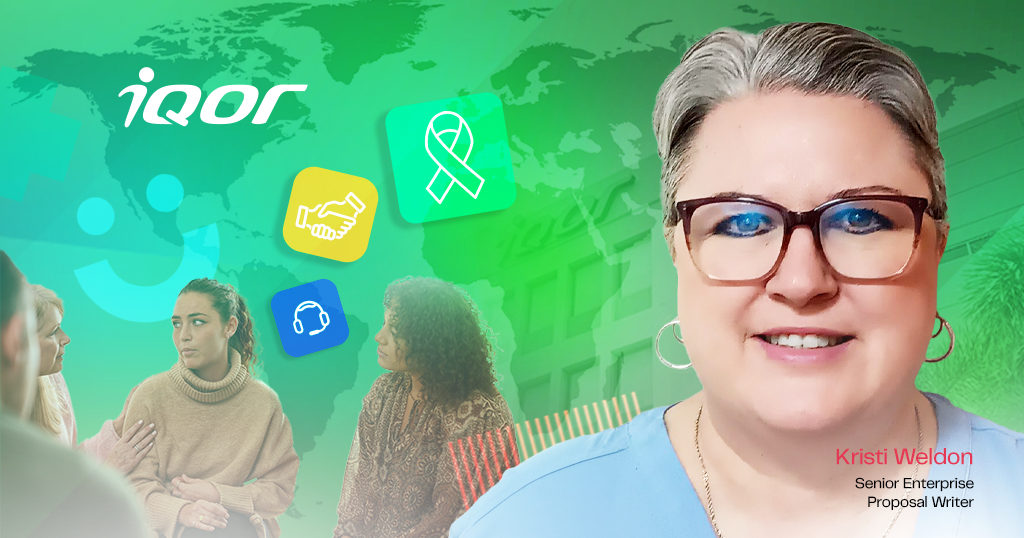
iQor Senior Enterprise Proposal Writer Kristi Weldon shares her personal mental health journey, providing invaluable insights into the intersection of her mental well-being and her professional life. Her story is one of resilience and advocacy, inspiring all of us to take mental health seriously, both for ourselves and our colleagues. 

Finding Strength in the Struggle

Kristi’s journey with mental health began in her early teenage years when she struggled with depression and suicidal thoughts. At the time, she didn’t have the language to describe her emotions and wasn’t aware that her overwhelming feelings were symptoms of depression.  

Kristi mustered the courage to reach out to her school guidance counselor, but her family’s reaction was less than supportive due to the stigma surrounding poor mental health. Her family’s concern about the social perception of her struggles only reinforced the isolation she felt. 

It wasn’t until years later that Kristi was diagnosed with bipolar disorder at age 32. A turning point in Kristi’s journey came during a hospitalization due to suicidal thoughts. This pivotal moment gave her a deeper understanding of her anxiety and bipolar disorder, and, with the support of healthcare professionals, she learned how to manage her mental health more effectively. 

“Had I not gone through that hospitalization, I would be struggling with something that I don’t have to and that there’s treatment for.”

Overcoming Misconceptions About Mental Health

Kristi has also experienced deep-seated stigmas attached to mental health. Throughout her life, she’s faced situations where people reacted negatively when learning about her diagnosis. She recounts a moment during a writer’s meeting when she mentioned being bipolar. An attendee picked up his chair and moved away from her, treating her as though she had a contagious disease. 

Despite hurtful encounters such as this, Kristi remains committed to breaking down unfair beliefs surrounding mental health. Rather than internalizing these reactions, she views them as a reflection of others’ ignorance, not a judgment of her own worth. Through her openness, Kristi aims to show that mental health challenges are nothing to be ashamed of and that seeking help is a sign of strength, not weakness.

“Anyone at any given time can have a mental health challenge.”

You Are Not Alone

Kristi emphasizes the importance of building a supportive network to mitigate feelings of loneliness. Building connections with others — whether through personal relationships or professional support systems — can make a significant difference for individuals dealing with mental health issues. 

The Importance of a Supportive Workplace Environment  

When Kristi first joined iQor in 2021, she kept her mental health struggles private. For the first year and a half, no one knew about her mental health challenges. She was hesitant to disclose this due to negative experiences in past workplaces where she had been “burned” before.  

However, as she settled in, she recognized the importance of fostering a safe and supportive workplace. Kristi says that when employees feel comfortable disclosing their mental health challenges, they are happier and more productive.  

Leaders play a critical role in this. Kristi’s boss created an open and supportive environment that empowered her to seek help and feel comfortable at work. Kristi’s advice to leaders is clear: recognize that employees may be struggling with undiagnosed mental health issues and cultivate a workplace where they feel safe to seek help and receive the support they need.

“I’m very fortunate to have a wonderful boss who’s been very supportive of me and has allowed me to be open and communicative about my issues.”

The Role of Professional Support and Employee Assistance Programs 

Professional support systems, such as employee assistance programs (EAPs), are invaluable for employees navigating mental health challenges. Kristi credits her diagnosis and subsequent mental health management to the support she received through her employer’s EAP, which provided her with access to specialists and essential resources. EAPs play a critical role in helping employees manage mental health by offering short-term counseling and referrals for long-term care.  

“It was a counselor through work that actually got me help and got me diagnosed initially,” Kristi shares, highlighting how crucial these programs can be in providing employees with access to life-changing resources. 

Moreover, Kristi underscores the importance of seeking specialized mental health professionals. For her, psychiatric specialists provided the expertise needed to tailor her treatment effectively. Following the guidance of healthcare professionals is key to successfully managing mental health. 

Balancing Career and Mental Health

For Kristi, balancing a demanding career with mental health challenges has been a journey of self-awareness and adaptability. One of the key lessons she’s learned is the importance of finding a role that aligns with your strengths and preferences. Kristi thrives in a high-stress, fast-paced environment, describing her work style as similar to that of a sprinter — handling short bursts of intensity. She acknowledges that this approach isn’t for everyone: “Figure out what you like, what you’re good at, and what you enjoy, and start from there to build your career while balancing your mental health.” 

Another important aspect of maintaining this balance is setting boundaries and incorporating mental health needs into your daily routine. Kristi explains that if you require time for self-care, such as journaling or therapy, finding a job with flexible hours can make all the difference. “Build balancing your mental health into your career,” she encourages, stressing the importance of crafting a professional life that supports rather than hinders your well-being. 

By setting realistic expectations and learning when to step back, she’s been able to create a healthier, more sustainable work-life balance. Her story highlights that success in both career and mental health requires ongoing self-awareness, flexibility, and the courage to prioritize your well-being. 

Kristi’s Strategies and Coping Mechanisms

In addition to professional support, Kristi has developed a range of strategies to help manage her mental health. She finds solace in daily practices like journaling and meditation, which allow her to process her emotions and stay centered. Music is also a vital part of her routine, and she often turns to her favorite band, Shinedown, whose songs frequently explore themes of mental health. “They’ve been singing about mental health for 20 years,” Kristi explains, underscoring how their music has become a grounding force that helps her navigate difficult moments. 

Visualization exercises, which are mindfulness techniques in which individuals create vivid images in their minds, are another tool Kristi uses to stay focused and maintain emotional balance. These techniques and her dedication to self-care help her manage the challenges of a high-pressure job while maintaining her well-being. 

When it comes to handling negative reactions to her mental health, Kristi’s approach is both empowering and pragmatic. Rather than engaging in conflict, she chooses to let others’ reactions reflect their own ignorance, not her worth. “The only thing I can control is me,” she says, highlighting the importance of self-awareness in managing both internal struggles and external perceptions. Her calm and composed mindset allows her to protect her peace while educating others about mental health through her actions. 

Kristi’s Career Journey and Message to iQor Employees

Kristi’s career path is a testament to her resilience and determination. With roles ranging from sales to teaching to her current position as a senior enterprise proposal writer at iQor, Kristi’s professional journey is marked by significant achievements. Her credentials — including a CF-APMP certification through the Association of Proposal Management Professionals (APMP) — and her leadership role as iQor’s Loopio Champion for Loopio proposal management software highlight her dedication to her work.      

To her colleagues at iQor and beyond, Kristi’s message is one of hope and solidarity. She encourages employees to utilize the mental health resources available through the company’s benefits and to seek support when needed. Understanding the varied perceptions of mental health across different regions across the globe is also crucial in fostering an inclusive and supportive work environment.   

At iQor, supporting mental health is an integral part of fostering a diverse, equitable, and inclusive workplace. As Kristi’s story illustrates, mental health challenges can impact anyone, and creating an environment where employees feel safe to seek support is essential. iQor’s commitment to diversity, equity, and inclusion (DEI) extends beyond recognizing differences — it involves actively providing resources and creating spaces where all employees can thrive, both personally and professionally. 

iQor encourages every team member to embrace their unique journey. Together, we can continue to break down barriers, reduce stigma, and ensure that everyone feels valued and supported. 


Kristi Weldon is a senior enterprise proposal writer at iQor who advocates for mental health resources and well-being. She is also the leadership cohort and chair for the APMP Mental Health Affinity Group. Connect with Kristi on LinkedIn to discover more about her mission to strengthen mental health awareness in the workplace. 

At iQor, creating a safe space for employees to seek support is essential. If you or someone you know is facing a mental health crisis, please download our list of available helplines for suicide prevention and mental health resources across the countries where we operate.  


How Machine Learning Can Help You Reduce Frontline Employee Attrition

Leveraging Machine Learning to Predict Employee Attrition Risks and Guide Retention Interventions  

How Machine Learning Can Help You Reduce Employee Turnover is a free webinar available on demand, presented by iQor’s Vice President of Operations Terri Robertson, Senior Vice President of IT Joe Przybylowski, and Data Scientist Andrew Reilly. Here’s an overview of what they discussed.  

Why Retention Strategies Are Critical to Your Business Success 

Employee attrition is a more pressing concern for organizations than ever, as evidenced by cultural dialogue like “The Great Resignation” and “quiet quitting.” Attrition is even more significant for BPOs like iQor whose business is to deliver outsourced customer service to the brands that entrust us. 

The cost of employee attrition is significant in both direct and indirect ways. For example: 

  • The average cost to hire and train a replacement employee can be up to 200% of that employee’s salary
  • Replacing an experienced employee with a new hire can lead to a decrease in productivity and efficiency, which can affect revenue. 
  • A high turnover rate can lead to discontinuity in customer service, which can result in loss of business. 
  • High turnover can impact morale among other employees and cause a snowball effect of attrition, incurring further costs.  

The value of investing in employees speaks for itself. At iQor, employee experience is a cornerstone of our business model. Creating a work environment that promotes job satisfaction, recognition, and growth opportunities is critical to retaining valuable tenured employees. Optimize the customer experience through human-centric interaction with agents.

Using Predictive Analytics to Help Prevent Attrition With Proactive Retention Strategies at iQor 

For over 15 years, iQor has used cutting-edge technology to provide an irresistible employee and customer experience (CX). Our team of expert data scientists has developed models for predictive analytics to guide our strategies for revenue recovery, customer satisfaction (CSAT), net promoter scores (NPS), and more. So, why not leverage our data analytics expertise to predict attrition before it has a chance to materialize?

Using the power of predictive analytics, we asked the fundamental question of attrition: How do you know when an employee is thinking about leaving?

To answer this question, our team of expert data scientists developed a machine learning model to identify variables that correlate with attrition and predict which employees might be at risk of leaving the company. Our goal was to play offense rather than defense to the problem of employee attrition by developing proactive retention strategies for at-risk employees. The model successfully:  

  • Analyzes which variables influence employee attrition. 
  • Identifies employees at risk of attrition. 
  • Guides our operations team’s retention strategies. 
  • Contributes to the retention of thousands of at-risk employees. 
  • Informs an improved employee experience through a culture of empathy and professional development opportunities

Using the power of predictive analytics, we asked the fundamental question of attrition: How do you know when an employee is thinking about leaving?

Customized Employee Retention Processes Guided by Predictive Analytics 

Predictive analytics placed the ball in our court to proactively shape a positive employee experience that improves retention. The foundation of machine learning and predictive analytics is data. To begin, iQor’s data scientists needed to know what data they required to build their “crystal ball” for proactive employee attrition prediction. 

Their approach to data modeling consists of three stages: 

1. What data is available?  

The existing body of structured data could include tenure, compensation and benefits, workforce management data, interaction analytics, coaching outcomes, performance reviews, bonus history, training data, and other information that iQor already gathered about our employees.  

2. What are we missing?  

After conducting an inventory of existing data, we could identify data gaps. Gaps often include unstructured data, which is more difficult to gather and too subjective to easily evaluate, such as employee feedback.  

3. What can we create?  

Identification of data gaps can then drive strategies for gathering that data. For example, annual surveys for employee feedback are an option, but that doesn’t provide enough data for accurate analytics. Filling in this gap requires a high-frequency method of employee surveying for gathering reliable and timely feedback regarding their outlook on the job.  

The answers to these questions create a broader data pool of structured and unstructured data to begin identifying which data points correlate to attrition risks. 

Transforming Raw Data Into Usable Variables  

Data is just raw material; it needs to be refined to be useful, as described by Gartner’s Four Phase Data Maturity Model. iQor’s data scientists had to decide how to categorize the data into variables that could be computed by their algorithms. They then validated each data feature using a process called variable importance testing to determine what to include and exclude from the production model. This process assesses how much influence a particular variable or feature has historically impacted our attrition. Those that rank high are selected while those that rank low are rejected. 

Using these variables and a combination of five main algorithms, our data scientists deployed a five-fold cross-validated Stacked Ensemble Meta learner with auto-tuned hyperparameters—or, in layman’s terms, they created a customized employee retention model that could assess the probability of employee attrition within the next 60 days. 

From Data Science to Pragmatic Action: The Plan for Proactive Frontline Employee Retention 

At iQor, we place a high value on providing exceptional employee experiences. As our data scientists and operations teams collaborated to develop a practical, specific, repeatable process for proactive retention, they kept the employee experience top of mind. The process needed to be simple for employees and managers in terms of time and effort expended; it needed to be standardized yet flexible; and it needed to be embeddable into our feedback culture. The result was a Measurable Skip-Level Meeting, also known as “The Touch Base.” 

“The Touch Base” Strategy for Employee Retention  

Every week, iQor runs our machine learning model for all 40,000 employees company-wide. We analyze each individual’s probability of attrition between 0% and 100%. At-risk employees are identified at a threshold of 65%. Employees who meet or exceed this threshold for attrition risks will automatically engage the company’s proactive retention strategy enacted by the operations teams. 

As a result of these analytics, our operations teams are informed of at-risk employees every week. They receive the employees’ names, the names of their direct supervisors, and the skip-level managers responsible for scheduling the Touch Base. These managers have a structured guide with clear, consistent guidelines, a system of record, and a method for feeding results back into the analytics model. 

The Touch Base is standardized enough to provide data points that can guide improvements to the machine learning model but also conversational and customized to each employee’s needs.  

It’s important to note that the Touch Base is not focused on the employee’s performance. Rather, it is about encouraging open communication to identify and support the employee’s needs. The anatomy of the Touch Base is as follows:  

  • Before the Touch Base 
    • The manager reviews the employee’s information to approach the conversation with an informed and empathetic mindset. 
    • The manager schedules the 30-minute session with the employee through our workforce management system.  
  • During the Touch Base 
    • The manager asks open-ended questions in an effort to identify what the employee may be experiencing that makes them at risk.  
    • The manager lets the employee guide the conversation to help the employee feel listened to, valued, and supported.  
    • The manager thanks the employee for their time and willingness to share. 
  • After the Touch Base 
    • We use the same module that guides our coaching to measure the effectiveness of each Touch Base. The Touch Base checklist includes a summary with the following priorities: 
      • Clarify timelines, deliverables, and expected outcomes. 
      • Agree on next steps. 
      • Schedule a follow-up meeting with the employee. 
      • Escalate to the next level of management, if needed. 
    • Lastly, the manager documents the meeting in the system with as many details as possible. 

The manager also rates the Touch Base for their impression of the employee’s overall state of being. In some cases, just having the conversation with the manager can make the employee feel valued and clear up the risk of attrition. In other cases, the situation is not something the manager can easily address, and escalation may be necessary.  

Combining Clinical Trial Methodology and Human Storytelling to Gauge the Effectiveness of the Touch Base Process and Guide Next Steps 

For iQor’s machine learning model to be effective, it has to be able to measure the effectiveness of our interventions and the results of these Touch Base meetings. We performed a controlled study, much like a clinical trial, to go beyond the manager ratings to use a scientific approach to our evaluations.  

Comparing Retention Outcomes Between Control and Experimental Groups Showed a 2.6x Increase in Retention for Touch Base Employees 

Out of 100 at-risk agents, we withheld a small sample of at-risk agents to serve as a control group. They received no Touch Base interventions. The other 95% served as the experimental group and proceeded through our Touch Base intervention process. The results were clear. After 60 days, the control group experienced 18.3% attrition while the experimental group experienced 7% attrition.  

This led to two main findings:  

  1. The model appropriately identifies employees at risk of attrition. 
  1. The intervention is meaningful.  

At-risk employees who go through the Touch Base process are 2.6 times more likely to stay with the company than employees who do not receive proactive retention strategies. We refer to this as our Attrition Mitigation Factor. The takeaway? Our Touch Base strategy worked to effectively retain at-risk employees and embody our commitment to providing an outstanding employee experience.

Attrition Mitigation Factor, How Machine Learning Can Help You Reduce Employee Turnover

Stories Shared by Agents and Managers Through a Culture of Feedback Relate Positive Outcomes Beyond the Science 

What steps actually work to retain at-risk employees? The answer to this can help us implement a repeatable process and create a culture of feedback. Feedback and storylines from our operations teams about their experiences with the Touch Base process guides continuous improvement to the model.  

Using the Touch Base process, managers now get to talk directly to frontline employees instead of just hearing from their direct managers. This makes it much easier to find resolutions and improve relationships to encourage retention. When managers listen, they can facilitate adjustments that lead to employee retention. Sometimes, preventing employee attrition is as simple as adjusting schedules. 

Putting the “Active” in “Proactive:” How the Machine Learning Model Constantly Self-Improves 

iQor’s machine learning model is dynamic. Future improvements are guided by the data science team, the operations team, and stakeholders, who have the opportunity to provide feedback and ask questions during quarterly reviews. The key is data. Each time the machine learning model processes new information, it improves its own ability to fulfill its intended purpose.  

Best Practices for a Machine Learning Approach to a Proactive Retention Strategy 

iQor’s machine learning model is successful because our data science, operations, and frontline teams collaborated to define, implement, and improve the process. Embodying our iQorian Value of open communication helped our teams develop an effective machine learning model that kept the human experience at the forefront of the process. 

Here are some best practices our teams followed: 

  • Define the problem in as much detail as possible through collaboration, data discovery, and analysis.  
  • Acquire high-quality data by asking three main questions: what data do we have, what data can we create, and what data can we enrich by joining it to another data source? 
  • Name the project to give it its own brand. Our Touch Base system makes the project memorable to stakeholders and builds value.  
  • Create a control group like a clinical trial to evaluate results for an accurate indication of effectiveness.  
  • List all KPIs to specifically define the model’s parameters.  
  • Start with a quick win to motivate involvement and maximize collaboration potential.  
  • Fail small and fast to allow the data science methodology to break the project into bite-sized pieces that are not overwhelming.  
  • Communicate between teams so they can seek support across the organization. Establishing a regular cadence for communication keeps channels open that we can use as potential input sources for continually improving the model. 

Investing in Employees to Retain Tenured, High-Performing Teams 

Employee attrition can be a significant issue for any company. Our proactive retention strategies help us stay ahead of the curve through processes that incentivize valuable employees to stay on board. iQor’s machine learning model successfully predicts attrition and guides effective intervention strategies, empowering us to transform at-risk employees into tenured career professionals that provide irresistible customer service.  

Experience the Best in CX  

iQor offers analytics as a service to enhance employee, customer, and client outcomes. Our proprietary speech analytics platform, cloud computing, machine learning, artificial intelligence, and data analysis enable us to provide effective workforce management solutions, flexible work environments, and improved coaching processes. We prioritize our employee experience and aim to cultivate a culture of success that fosters loyalty and high performance. 

As a managed services provider of customer engagement and technology-enabled business process outsourcing (BPO) solutions, iQor provides a comprehensive suite of full-service and self-service scalable offerings that are purpose-built to deliver enterprise-quality CX.  

Our award-winning CX services include:  

  • A global presence with 40+ contact centers across 10 countries.  
  • A CX private cloud that maximizes performance and scales rapidly across multiple geographies on short notice.  
  • A partnership approach where we deploy agents and C-level executives to help maximize your ROI.  
  • The perfect blend of intelligent automation for scale and performance coupled with an irresistible culture comprised of people who love to delight your customers.  
  • Virtual and hybrid customer support options to connect with customers seamlessly, when and where they want.  
  • The ability to launch a customer support program quickly, even when you need thousands of agents ready to support your customers.  
  • A best-in-class workforce management team and supporting technology to create a centralized organization that can better serve your entire business.  

iQor helps brands deliver the world’s most sought-after customer experiences. Interested in learning more about the iQor difference? If you’re ready to start a conversation with a customer experience expert, contact us to learn about how we can help you create more smiles. Heart

Joe Przybylowski is senior vice president of IT at iQor. Connect with him on LinkedIn.
Andrew Reilly is a data scientist at iQor. Connect with him on LinkedIn.
Terri Robertson is vice president of operations at iQor. Connect with her on LinkedIn.

The 5 Essential Pillars of Zero Trust for BPOs

Why BPOs Need to Continuously Invest in Zero Trust

The threat landscape is constantly changing, and a static security model is not an option. Zero trust is a dynamic approach to security that enables BPOs to stay ahead of the curve. By continuously investing in zero trust, BPOs can protect their data and systems from the latest threats and ensure a secure environment for the mountains of client data they store, handle, and analyze. 

What Is Zero Trust? 

Zero trust is a security concept created by cybersecurity expert John Kindervag. The phrase he coined, “Never trust, always verify,” has become the watchword of zero trust advocates and practitioners. 

Kindervag broke new ground when he recognized that every instance of trust in a network represented a vulnerability. As he saw it, every user and every device needed to be authenticated and authorized before it could access any part of a network. With zero trust, no activity on the network, no matter where it originates, is presumed to be trustworthy. 

Zero trust was a major departure from the status quo, which built security on the idea that a secure perimeter around a network would keep the network safe—much like a moat around a castle. Security experts presumed activities inside the perimeter to be trustworthy because an actor had to pass through perimeter security to get inside. But as with a castle, once a bad actor penetrated the perimeter and was inside, they could wreak havoc. 

The Castle-and-Moat Approach No Longer Provides Enough Protection

The castle-and-moat approach was fine when everyone worked from the office and the network server was on premises. Today, businesses have data in data centers, in the cloud, in branch locations, and on endpoint devices. Employees work at home, a hotel, or their neighborhood coffee shop.  

This is the era of the distributed network, and cybercriminals have more ways than ever to penetrate a network.  

How much havoc are bad actors causing? Every 11 seconds a business is hit by a cyberattack. According to Cybercrime Magazine, if Cybercrime were a country, it would have the third largest economy in the world, behind only the U.S. and China.  

Fortunately, zero trust is catching on.  

Standards Help Business Process Outsourcers (BPOs) Transition to Zero Trust 

Zero trust is a concept, not a product. You can’t set it and forget it. For years, zero trust experts often described it in different ways, which could be confusing for BPOs that wanted to implement zero trust and build a zero trust architecture (ZTA).  

That changed when, after a series of data breaches in various agencies, the U.S. government made a strong commitment to zero trust. The National Institute of Science and Technology (NIST) published NIST 800–207, “Zero Trust Architecture,” to help organizations transition from legacy security systems to zero trust. In 2021 and 2022, the president issued executive orders requiring all U.S. federal agencies to adhere to NIST 800–207 and to ensure the responsible development of digital assets. 

Now vetted and validated by many commercial customers, vendors, and government agency stakeholders, private organizations and enterprises widely recognize NIST 800–207 as the reigning zero trust standard. By providing helpful guidance—especially for organizations with no experience in zero trust—NIST 800–207 has provided clarity for BPOs and all organizations that want to phase in zero trust.  

3 Principles of Zero Trust 

CrowdStrike cites the three principles of zero trust as: 

  • Continuous verification. Verify all users and their permitted level of access before granting access to any resources. Only “least-privileged access” should be granted to any user, meaning users have access to only the resources they need. 
  • Limit the “blast radius.” In case a breach does occur, minimize the damage it could cause. 
  • Automate context collection and response. Automatically analyze behavioral data against the entire IT stack to develop the most accurate response to an access request or perceived threat. 

Zero Trust Needs of BPOs 

When a BPO manages an omnichannel customer experience (CX) program, massive amounts of data (Big Data) are collected. Every customer interaction—phone, text, chat, email—is recorded and analyzed. Various applications are used to analyze the data produced from these interactions. Automation makes processes more efficient.  

Hundreds or thousands of customer service agents and supervisors, many of whom work at home (WAH), have access to the data. Agents providing back office services handle thousands of personally identifiable records.  

These activities are repeated for every client, every day.  

And these 5 pillars of zero trust protect them from bad actors. 

5 Pillars of Zero Trust for BPOs 

Regardless of the scope of a dynamic zero trust implementation, these five pillars are must-haves for BPOs. 

1. Multifactor Authentication

Multifactor authentication hardens security access to networks by requiring users to confirm their identity through two or more factors. Authentication factors are things you… 

  • Know: username/password, PIN, security questions. 
  • Have: RSA key, fast identity online (FIDO) key, phone, registered endpoint, certificate. 
  • Are: biometric scan – fingerprint, palm, eye, voice, facial. 
  • Locate: source IP, known device location, GPS. 

Organizations can use multifactor authentication in numerous ways, including: 

  • OTP: After entering your user ID and password, the system asks you how you’d like to receive a one-time password (OTP), via SMS, chat, or email. After you select your preferred method, the system sends you the OTP and provides a form field for you to fill in after you’ve received it. 
  • Third-Party Sync: At the login screen, the system asks for your password and an OTP provided by a third-party application that syncs the OTP it sends to your smartphone with the login page. 
  • Biometric Scan: Login includes a user ID, an OTP, and a fingerprint scan. 
  • Hardware Token: To log in, press the button on your hardware token device to generate a new passcode and enter it into the first or second password field on the login screen. 
  • FIDO2: Open-standard FIDO2 delivers hardware-based authentication through your existing FIDO2-enabled device such as a smartphone, security key, or hardware token enabling you to simply enter your biometric or pin-based authentication to log in. 

Multifactor authentication emerged as an important line of defense against bad actors as they became more adept at stealing user IDs and passwords through brute force (trial and error) and social engineering (convincing people to divulge their login credentials) attacks, such as: 

  • Phishing: Using fraudulent emails and websites to deceive users into revealing personal information or inadvertently installing malware. 
  • Smishing: Using text messages or messaging apps to obtain sensitive information from unsuspecting individuals. 
  • Spear Phishing: More personalized than phishing, spear phishing targets a specific person or group with a personalized message seemingly coming from a known sender. 
  • Keyloggers: Often installed through vulnerable browsers that fall prey to bad actors, a keylogger records every keystroke made by the user to gain access to confidential information. 
  • Credential Stuffing: Attackers use lists of credentials obtained through a data breach in one system to gain access to another system. 
  • Brute Force and Reverse Brute Force Attacks: Bad actors obtain the username or account number (brute force) or password (reverse brute force) and use automation tools to determine the missing key to gain access. 
  • Man-in-the-Middle (MitM) Attacks: Bad actors intercept messages between two parties to obtain and/or alter data with malicious intent. 

While multifactor authentication may add a minute to the login time, it adds an important layer of protection to the network by making it much harder for bad actors to get in. 

2. Network Security and Microsegmentation 

Multifactor authentication provides protection against bad actors trying to breach the network’s perimeter. 

Microsegmentation protects the network from bad actors who somehow make it into the network and then attempt to cause damage throughout the network. 

Microsegmentation employs software to virtually isolate parts of the network where applications can run—known as a workload—from each other.  

With each workload isolated and every attempt to move from one workload to another requiring authentication and approval, microsegmentation limits any damage done in one workload from reaching another. It also ensures that any user in one workload who attempts to access sensitive data in another workload has the appropriate permissions. This is an area of continued investment for iQor into 2024 and beyond.  

3. Data Security 

Multifactor authentication and microsegmentation protect areas and resources of the network from bad actors. Zero trust data protection (ZTDP) protects the data itself by applying the principles of zero trust (detailed above) to data. In other words, ZTDP is an extension of zero trust. Instead of being network and resource centric, ZTDP is data centric. 

Even with data, never trust, always verify.  

With ZTDP, both structured and unstructured data—whether in a database, in a protected file store, or on the move (in use)—are protected by requiring that users be authenticated and granted only least-privileged access. This necessitates access policies at the most granular levels. 

In granting access, the context of the access request is considered. Contexts to be considered might include: 

  • Is the request coming from a user or an application?  
  • Is it known how the requestor will use the data? 

Automation is used to evaluate and enforce access policies. All data requests are logged, regardless of the outcome of the request. 

4. Device Authentication and Authorization

Authentication and authorization are two steps that sound similar but have different meanings. 

Authentication is the process by which a user or device is confirmed to be who they claim to be. Typically, the network authenticates users by their user ID, password, and another required authentication factor.  

Devices are often authenticated by IP address. If the authenticated user’s IP address is what’s expected, the device is authenticated for that user. If the authenticated user’s IP address isn’t what’s expected, the network may ask for further proof that they are who they claim to be. Also, a notification may be sent to the user that someone has logged in with their credentials from an unrecognized device, instructing them to contact the network administrator if it wasn’t them. 

Much of the communication in complex networks is between devices that work autonomously, such as routers and switches. To make sure bad actors don’t mimic these devices, security teams use encryption to protect and send data between devices.  

Authorization is the process of providing least-privileged access to the authenticated device for areas and resources requested.  

This principle of least privilege (PoLP) is a foundational aspect of zero trust to help improve an organization’s security posture by reducing their attack surface. The process of authorization involves verifying the user’s or device’s identity and then assigning access privileges that correspond to the user’s role, responsibilities, and need-to-know. This is typically done by assigning the user or device a set of permissions that dictate the applications, data, and resources they can and cannot access. 

5. Continuous Monitoring of All Actors 

The transition from traditional unified networks with castle-and-moat security models to zero trust raises three important topics for IT: visibility, automation, and analytics. 

Visibility 

IT maintains a high level of resource visibility in a traditional network. With zero trust and network microsegmentation, resources are segmented into small pieces. Traditional monitoring and network management were developed to provide visibility to one network, not to many small segments that comprise a network.  

Lack of visibility can lead to a network with unpatched devices, unmonitored systems, and shadow IT, where IT-related hardware and software are used without the knowledge and consent of IT or security. 

Meanwhile, zero trust depends on continuous monitoring of all actors. Automation and analytics make up for the visibility deficit. 

Automation and Analytics 

Zero trust relies on software that automatically and consistently monitors all network segments, data correlations (how strongly sets of data are linked together), and logs to form a baseline of user behavior.  

When analysis of the monitored data indicates there are anomalies in user behavior, they are reported to IT and security stakeholders as potential threats in real time. Real-time notification gives stakeholders their best chance to mitigate a threat before it does any damage. 

Benefits to BPO Clients 

When BPOs implement the five pillars of zero trust to protect their networks, their clients can feel confident that the BPO is taking every step to limit access to their data to users with the proper access privileges.  

They can also feel confident that their BPO takes strong measures to protect their own operations against bad actors, so the business processes the client outsources to them have less chance of being compromised by cyberattacks. 

These practices offer BPO clients peace of mind that their outsourced business processes are protected so they can focus on achieving desired KPIs. Optimize the customer experience through human-centric interaction with agents.

Zero Trust Is the Future of Security for BPOs 

Brands in all sectors are evaluating and in some stage of their planning a zero-trust security implementation.  

BPOs use Big Data to find new agent-coaching opportunities to predict employee attrition and much more. They save, manage, and analyze massive amounts of data and can’t afford to have that data breached, stolen, or corrupted. Zero trust is the standard that provides maximum cyber protection for BPOs and their clients. 

Zero trust requires considerable know-how and time to implement. There’s no such thing as a “finished” zero trust program. Technology keeps changing, and cybercriminals keep finding more ways to breach systems to deny service, steal secrets, or demand ransom. As circumstances change, organizations that employ zero trust need to change with them. 

As more BPOs implement zero trust, brands in search of a BPO may well start asking, “How are you coming along on your zero trust security roadmap?” 

As BPOs continue to invest in and implement zero trust practices, brands in search of a BPO partner can discuss current and planned zero trust initiatives.  

Experience the iQor Difference 

At iQor, we partner with clients to design the optimal mix of CX automation and people where security is always top of mind. As a managed services provider of customer engagement and technology-enabled business process outsourcing (BPO) solutions, iQor provides a comprehensive suite of full-service and self-service scalable offerings that are purpose-built to deliver amazing customer experiences. 

Our award-winning CX services include: 

  • A global presence with 40+ contact centers across 10 countries. 
  • A CX private cloud that maximizes performance and scales rapidly across multiple geographies on short notice. 
  • A partnership approach where we deploy agents and C-level executives to help maximize your ROI. 
  • The perfect blend of intelligent automation for scale and performance coupled with an irresistible culture comprised of people who love to delight your customers. 
  • Virtual and hybrid customer support options to connect with customers seamlessly, when and where they want. 
  • The ability to launch a customer support program quickly, even when you need thousands of agents ready to support your customers. 
  • A best-in-class workforce management team and supporting technology to create a centralized organization that can better serve your entire business. 

iQor helps brands deliver the world’s most sought-after customer experiences. Interested in learning more about the iQor difference? If you’re ready to start a conversation with a customer experience expert, contact us to learn about how we can help you create more smiles. Optimize the customer experience through human-centric interaction with agents.

John O’Malley is SVP, Chief Information Security Officer at iQor. Connect with John on LinkedIn. 

How to Use Machine Learning to Power Conversations and Retain More Contact Center Employees

Improve the Employee Experience for Customer Service Agents and Supervisors Through Conversations Informed by Predictive Analytics   

Creating rewarding employee experiences and retaining employees is key to running any business. Using machine learning as a retention enabler is the focus of this blog post. 

While appearing on CNBC in 2019 to announce a new tool IBM had created—with AI, machine learning, and predictive analytics—to identify employee flight risk candidates, former IBM CEO Ginni Rometty said, “The best time to get to an employee is before they go.”  

By harnessing digital technology innovation, forward-thinking business process outsourcers (BPOs) can take action to reduce employee churn—especially among frontline workers.  

In this blog post, we’ll explore how BPOs can use machine learning and predictive analytics to retain more contact center employees by assessing frontline employee attrition risk and leveraging that knowledge to create an employee experience that often addresses their unique needs.  

We’ll cover: 

  • Employee retention in the 2020s. 
  • Costs of replacing contact center employees who leave. 
  • Modeling data to identify employee attrition risk patterns. 
  • Predicting and reporting employee attrition risks. 
  • Intervening to retain employees. 
  • Measuring intervention outcomes. 
  • Calculating the impact of intervention on P&L. 
  • A real-world example.

Employee Retention in the 2020s  

Since the onset of the pandemic, employee retention has become an even greater challenge than it was when Ginni Rometty appeared on CNBC in 2019.  

A global survey by PwC revealed that, across all lines of work, one in five employees expected to find a new opportunity in 2022.  

Digitally savvy BPOs use every tool at their disposal in an attempt to retain their frontline customer experience team members. 

Costs of Replacing Contact Center Employees Who Leave  

Direct and indirect costs add up quickly when replacing contact center employees who leave voluntarily. 

Direct costs include recruiting, onboarding, and training each new employee. It can take months to hire a new employee and train them to become fully versed in a new customer experience position. 

Indirect costs become factors the moment an employee departs. That’s when the employer loses the employee’s skillset, everything the employee learned about the company and the CX program they supported, as well as internal processes when working with their team and stakeholders.  

Moreover, teams have to cover the gap left by the departing employee until a new employee is onboarded and up to speed.  

When a team member departs, their loss can also lower morale. When an experienced worker leaves—especially one in a supervisory role—indirect costs rise even higher.

Watch Our Webinar

iQor SVP IT Joe Przybylowski, Data Scientist Andrew Reilly, and VP Operations Terri Robertson explain how iQor uses machine learning to help reduce employee turnover.  

Modeling Data to Identify Employee Attrition Risk Patterns

Organizations have long used annual surveys to measure employee sentiment. Surveys can provide a limited sense of how employees feel about working for an organization to help guide general improvements. Annual surveys are limited in their ability to identify individual employee sentiment and predict which specific employees are likely to leave, for several reasons: 

  • Many workers don’t complete the survey. 
  • Some workers might respond with what they think is the “right” answer instead of how they really feel. 
  • Some organizations only use anonymous surveys, so the organization doesn’t know which employees fit the profile of a flight risk. 

For a more accurate snapshot of individual employee sentiment, quick surveys conducted at regular intervals that identify employees are often more effective.  

Training the Machine Learning Model 

Data Scientists can use machine learning to analyze harvested data from former employees’ surveys and create profiles of employee sentiment that suggest when a worker is likely to voluntarily separate from the BPO. With these profiles, data scientists can create an employee attrition risk training model for a machine learning algorithm. As new data is compiled from existing workers and as more workers depart, machine learning automatically updates the algorithm to make it more accurate. 

Adding More Data Sources for Modeling Accuracy 

While using a single source of data may provide some guidance, there’s always a risk that the model is biased in some way, or that the sample size is too small. Using multiple data sources makes the model more accurate.  

Data scientists follow a formal process to identify and validate potential data sources based on elements of a worker’s environment, including how they interact with coworkers and supervisors. 

Environmental data sources might include: 

  • Schedule. 
  • Login and logout times. 
  • Frequency of breaks. 
  • Compensation. 
  • Complexity of the tasks assigned. 
  • Coaching interactions. 

Data scientists diligently explore other data sources through cross-functional analysis of processes.  

Predicting and Reporting Employee Attrition Risks 

Using multiple data sources minimizes bias built into a single data source. With enough data, predictive analytics (a subset of machine learning) can forecast which employees are the most likely flight risks and why they are at risk of leaving. 

Once data analysts have an accurate view of which employees are likely to voluntarily separate—and the probable causes for their separations—they share their findings with the employees’ managers. These reports get to the heart of who’s at risk and why, and spare managers the tedious task of having to decipher the data.  

The manager then determines the next step to take with each employee. Knowing the likely reasons an employee is an attrition risk gives managers a relevant starting point when they intervene proactively in their attempt to retain the employee. 

Intervening to Retain Employees 

Knowing why an employee is considering leaving can enable a manager to determine the best approach to resolve the employee’s concern, create a better experience for them, and help them remain on the team. 

When the manager is empowered to take an empathetic approach to intervening with the employee, they help the employee understand their commitment to resolving the concern. 

For example, if predictive analytics identifies an employee encountering scheduling concerns that make their job logistically challenging, the manager can work with the employee to design a more flexible schedule that better meets the employee’s needs. 

If, for instance, predictive analytics identifies an employee seeking additional career growth opportunities, the manager and employee can develop a plan to support the employee’s aspirations to learn and grow within the organization. 

With these and many other examples, when a manager knows the likely reasons an employee might voluntarily separate, they can tailor their approach to address the employee’s individual needs and create a better employee experience that recognizes their value to the organization and keeps them on the team.

More Real-World Examples

Learn How Machine Learning Can Help You Reduce Employee Turnover
Check out our webinar featuring iQor SVP IT Joe Przybylowski, iQor Data Scientist Andrew Reilly, and iQor VP Operations Terri Roberts to discover how to harness technology to engage employees and reduce turnover. Get the details directly from the experts responsible for this program. 
Watch Now

Measuring Intervention Effectiveness 

To determine the efficacy of interventions, companies run tests. Among a group of employee churn candidates, a portion is placed in a control group to measure the differences in outcomes between those who receive interventions and those who don’t.   

Calculations over time have proven how much more effective intervening is than not intervening to retain employees predicted to be at risk of voluntarily separating through the intelligent model explained in this blog post. This can result in significant boosts in contact center employee retention as well as improved overall employee experiences, including career advancement for retained employees.  

Bottom Line: Retaining Customer Experience Agents Improves CX 

Experienced customer service agents build relationships with their teammates, serve as mentors to newer agents, treat their customers with the care and respect they deserve, and champion the brand they represent. 

With machine learning and predictive analytics, BPOs can positively affect frontline employee retention and keep their employees and customers smiling. Heart

Experience the Best in Data Analytics  

iQor’s analytics as a service offering uses a combination of iQor’s proprietary speech analytics platform, cloud computing, machine learning, artificial intelligence, and data analysis to develop custom interventions for identified areas in need of improvement along the customer journey. The results produce targeted improvements for the employee, customer, and client. 

iQor is a business process outsourcing company ideally suited to help brands create amazing customer experiences. iQor provides a comprehensive suite of full-service and self-service scalable offerings that are purpose-built to deliver enterprise-quality CX. 

Our award-winning CX services include:   

  • A global presence with 40+ contact centers across 10 countries.   
  • A CX private cloud that maximizes performance and scales rapidly across multiple geographies on short notice.   
  • A partnership approach where we deploy agents and C-level executives to help maximize your ROI.   
  • The perfect blend of intelligent automation for scale and performance coupled with an irresistible culture comprised of people who love to delight your customers.   
  • Virtual and hybrid customer support options to connect with customers seamlessly, when and where they want.   
  • The ability to launch a customer support program quickly, even when you need thousands of agents ready to support your customers.   
  • A best-in-class workforce management team and supporting technology to create a centralized organization that can better serve your entire business. 

iQor helps brands deliver the world’s most sought-after customer experiences. Interested in learning more about the iQor difference? If you’re ready to start a conversation with a customer experience expert, contact us to learn about how we can help you create more smiles.   

Joe Przybylowski is SVP of IT at iQor. Connect with Joe on LinkedIn.
Andrew Reilly is a data scientist on the AI & Data Science Team at iQor. Connect with Andrew on LinkedIn.

5 Steps to Improve Coaching Effectiveness for Frontline Supervisors

Delivering Effective Coaching That Strengthens Performance in an Increasingly Complex CX Ecosystem 

5 Steps to Improve Coaching Effectiveness for Frontline Supervisors is a free webinar available on demand, presented by iQor and AmplifAI. David Arellano, head of product at AmplifAI, joined the authors of this blog post: Saurabh Bhaskar, iQor’s senior vice president of operations, and Anthony Paige, director of training and quality for iQor. Here’s an overview of what they discussed.

Measuring and Improving Frontline Coaching Effectiveness Is Critical 

Eighty percent of agents who leave contact centers do so because of their frontline supervisor. And the biggest challenge these supervisors face is usually their own interpersonal coaching skills. Effective frontline coaching is the best way to sustain and improve agent performance. This means measuring and improving frontline coaching effectiveness is critical to achieving desired outcomes. 

iQor invests heavily in recruiting, training, and coaching frontline employees. We want everyone we hire to enjoy a long and successful career with us. That’s why we provide professional learning opportunities and pathways to advancement. Coaching has always been a priority. 

Automation Has Changed Agents’ Roles 

In recent years, automation has taken on many of the more mundane tasks that agents used to perform, leaving them to handle more high-skill and high-value tasks.  

The growth of multi-channel and omnichannel customer experience—and all the digital CX technologies that make them possible—has enabled that complexity. Every CX interaction is recorded. Proprietary data analytics technologies scour recordings in search of opportunities for improvement through coaching and examples of best practices in action.  

Contact Center Complexity and Data Overload Create New Coaching Challenges 

Several years ago, the increasing complexity of the agent ecosystem began to leave supervisors wondering what their next coaching step should be. There was so much data and no efficient, effective, and accurate way to make sure coaching aligned with business priorities or measured coaching effectiveness. 

Fifty-six percent of contact center employees say job complexity is a top challenge. 

One Solution to Reduce Complexity, Identify Business-Critical Coaching Opportunities, and Measure Coaching Effectiveness 

We wanted to allow our supervisors to spend less time with data and more time coaching, so we researched numerous potential solutions.  

We invested in: AmplifAI, an AI-driven performance enablement platform that:  

  • Facilitates coaching events by surfacing the most impactful coaching opportunities. 
  • Reduces complexity by telling supervisors what they need to do next (based on specific coaching goals). 
  • Reports on agent performance in key areas. 
  • Identifies the type of coaching that agents and coaches need.  
  • Measures coaching effectiveness. 

How Webinar Attendees Rate Their Coaching Effectiveness of Frontline Employees 

14% 43% 14% 4% 25% 
Excellent Good Fair Poor Not Measuring 

Three years later, results from our strong partnership with AmplifAI—and the solution’s sophisticated AI and machine learning—have proved that investing in AmplifAI was the right decision.  

iQor employs AmplifAI to help coaches coach and measure coaching effectiveness. The five steps to improve coaching effectiveness show you how we work together. 

1. Create and Communicate Your Coaching System 

Your coaching system—the technology that facilitates the coaching process and measures coaching effectiveness—can only be as good as the coaching itself. 

iQor and AmplifAI align on what good coaching looks like: 

  • Proactive coaching with a specific goal in mind that enables the agent to perform their job better. 
  • Frontline leaders customize coaching to the individual agent’s learning style, whether that’s visual, audio, kinetic, or digital. 
  • Even in flexible work environments where agents can work at home or on premise, all agents are trained equally well.  
  • Supervisors need to be able to focus on their team, not the data, and provide specific actions the agent can deliver. 
  • Quick onboarding, consistent training, and effective coaching contribute to improved retention. 
  • Better employee experience translates to improved customer experience. 

To create your coaching system, you’ll also need clear expectations about:  

  • What the system can and will do for you. 
  • How much you’ll use the system for coaching. 
  • Methods you’ll use to facilitate coaching events. 
  • KPIs that are most important to the business. 
  • What constitutes coaching success. 

For iQor, the system provides easy-to-review performance data that show where everyone stands in relation to their goals, their team, and their program. 

2. Train Coaches How to Communicate and Develop Others 

In contact centers, supervisors are often former agents who were promoted from within.  

All agents need to be able to communicate effectively. Those who become supervisors (and coach others) also need to have the right underlying skillset, which includes the ability to help others change their behavior.  

At iQor, developing a new leader includes providing best practices for follow-through and leadership skills training. Plus, new leaders are trained to leverage technology that will help them be effective coaches. 

3. Provide Visibility Into Performance and Testing 

With AmplifAI, the system’s AI can be trained to identify coaching opportunities with the greatest potential impact and direct coaching activities to the right metrics, individuals, and tactics to add the greatest lift to performance.  

The AI cuts right through the complexity to show supervisors what they need to do next, offering coaching suggestions unique to each agent’s individual needs. This enables supervisors to save time they once spent determining which potential coaching opportunities to pursue—up to 40% of their time—and devote that time to coaching.

The AI cuts right through the complexity to show supervisors what they need to do next, offering coaching suggestions unique to each agent’s individual needs. This enables supervisors to save time they once spent determining which potential coaching opportunities to pursue—up to 40% of their time—and devote that time to coaching.  

Should KPIs change—along with the behaviors required to achieve success with those KPIs—the system can be tuned to reflect which coaching opportunities are important. iQor’s close working relationship with AmplifAI makes those kinds of changes easy to make. 

4. Measure Coaching Effectiveness 

Measuring coaching effectiveness is critical to understanding which coaches are doing exceptionally well and deserve recognition, and those who could benefit from coaching. 

5. Learn From Successful Coaches 

Many coaches are good at walking their agents through processes and expectations. Some are good at helping agents buy into and become a part of the learning and development process. Others are great at helping the agent understand how this change will benefit them. 

By measuring coaching effectiveness, you can identify where individual coaches could benefit most from coaching. 

AmplifAI points to the most successful coaching lessons in a given area. That enables other coaches to learn how to modify their own behavior based on how the most successful coaches teach those lessons. Also, coaches can use those lessons when coaching agents. 

The best coaching helps improve outcomes for agents, keeps agents more engaged, and contributes to their long-term success. 

The Proof Is in the Results 

When a telecom client asked iQor to shift their KPI emphasis from customer satisfaction (CSAT) to net promoter score (NPS), we turned to AmplfAI to identify opportunities to coach the behaviors needed to improve NPS. By focusing on the metrics that matter most, AmplifAI reduced the number of dashboards and reports that coaches were required to review. 

With a significant increase in coaching and more time spent on effective agent development, we produced these results for the client: 

  • 6x improvement in customer resolution time. 
  • An increase in NPS ranging from 2.5% at the beginning of the test period to an increase of 13% at the end of the test period. 
  • 40% more coaching sessions with tracking and accountability. 

Your Next Step 

For the complete case study details, plus charts, graphs, more in-depth discussion of the points referenced here, and an easy-to-understand look at how AmplifAI works, watch the webinar. It’s free and available on demand. 

Experience the Best in CX 

We partner with clients to design the optimal mix of CX automation and people. iQor is ideally suited to help brands create amazing customer experiences. As a managed services provider of customer engagement and technology-enabled business process outsourcing (BPO) solutions, iQor provides a comprehensive suite of full-service and self-service scalable offerings that are purpose-built to deliver enterprise-quality CX. 

Our award-winning CX services include: 

  • A global presence with 40+ contact centers across 10 countries. 
  • A CX private cloud that maximizes performance and scales rapidly across multiple geographies on short notice. 
  • A partnership approach where we deploy agents and C-level executives to help maximize your ROI. 
  • The perfect blend of intelligent automation for scale and performance coupled with an irresistible culture comprised of people who love to delight your customers. 
  • Virtual and hybrid customer support options to connect with customers seamlessly, when and where they want. 
  • The ability to launch a customer support program quickly, even when you need thousands of agents ready to support your customers. 
  • A best-in-class workforce management team and supporting technology to create a centralized organization that can better serve your entire business. 

iQor helps brands deliver the world’s most sought-after customer experiences. Interested in learning more about the iQor difference? If you’re ready to start a conversation with a customer experience expert, contact us to learn about how we can help you create more smiles. Heart

Saurabh Bhaskar is senior vice president of operations at iQor. 

Anthony Paige is director of training and quality at iQor.

The Benefits of RPA: How BPOs Help Organizations Save Time and Money With CX Automation

Business Process Outsourcing (BPO) Providers Add Strategic RPA Business Benefits to Projects 

As brands continually look to boost efficiency, productivity, and competitiveness in the marketplace, business process outsourcing (BPO) providers with digital transformation expertise offer unique insights and strategic value. This includes helping brands refine processes to achieve more loyalty throughout the customer journey. 

In recent decades, brands and analysts have come to recognize that BPOs understand how to navigate the options and opportunities created by business process optimization technologies. 

In recent decades, brands and analysts have come to recognize that BPOs understand how to navigate the options and opportunities created by business process optimization technologies.

One such technology—robotic process automation (RPA)—offers myriad business benefits, especially when deployed through a BPO with strategic digital transformation experience. 

Recognizing the Unique Business Benefits BPOs Add to Digital Transformation

In an August 2022 article, Gartner highlighted two unique benefits of partnering with a BPO for digital transformation.  

  1. Because BPOs consistently add technology to their tech stack, it’s easy for them to demonstrate how a given digital solution can help solve a client’s operational challenges. 
  1. By taking on vendor administration responsibilities for you, a BPO can remove two apparent needs: a) to hire more full-time employees and b) to give your IT staff additional work. 

Beyond these two benefits, BPOs bring a third benefit: objectivity. As third parties, BPOs can focus solely on the client’s objectives: to solve operational challenges, boost productivity, improve efficiency, and increase competitiveness while maintaining excellent customer and vendor relationships.  

As BPOs have demonstrated, these benefits apply to automation projects as well.

BPOs and Automation

Many BPOs that excel at digital transformation have also become experts in business process automation (BPA), an umbrella term that covers any type of automation used to streamline business processes and workflows, including robotic process automation.  

Like digital transformation, BPA is an increasingly popular and effective way to make business processes more efficient, workers more productive, and brands more competitive.

Rapid Expansion of RPA

From 2020-2026, global use of business process automation (BPA) is expected to grow at a compound annual growth rate (CAGR) of 12.2%, from $9.8 billion to $19.6 billion. 

The robotic process automation market is consistently the fastest-growing of all types of BPA. Forrester Research expects RPA deployment and support services to reach $12 billion in 2023. 

Forrester Research expects RPA deployment and support services to reach $12 billion in 2023.

Brands prefer robotic process automation to other forms of automation because it: 

1. Requires little support from IT, leaving them to perform their duties uninterrupted.  

2. Has proved its value across industries by automating a wide array of functions with accuracy, including: 

  • Manipulating and migrating files and data between different applications.
  • Entering and validating massive quantities of data (big data) from multiple systems.
  • Reconciling accounts.
  • Processing credit cards, mortgages, invoices, and insurance claims.
  • Detecting potential threats of bank fraud.
  • Planning resource needs and managing inventory.
  • Onboarding new employees.

RPA at a Glance 

RPA is a collaborative function of business stakeholders, users, RPA designers, and developers who automate processes on an RPA software platform.  

With RPA, software records a human’s clicks and keystrokes as they perform a high-volume, tedious, and repetitive process—such as data entry—on a digital interface. A virtual robot (bot) then mimics the human’s clicks and keystrokes, but much faster and with no errors.  

Like a human operator, an RPA robot can perform data entry tasks, open and close different applications, and use optical character recognition (OCR) software to digitalize data found on hard copy assets—such as printouts of Excel spreadsheets—and then use that data in the process. 

Today, RPA and digital transformation are often used on the same projects, so a thorough discussion of RPA must include digital transformation. 

In this blog post we’ll cover: 

  • Top Benefits of RPA for BPO clients. 
  • The RPA-digital transformation connection. 
  • Why a BPO with a proven digital transformation track record can multiply the benefits of robotic process automation. 
  • Experience the best in RPA 

Top Benefits of RPA for BPO Clients 

When asked, BPO clients cite the following benefits of robotic process automation. 

Boost Efficiency and Reduce Costs 

RPA saves time by assigning repetitive tasks to bots, which allows humans to focus on tasks that require critical thinking. Reducing the human time spent on repetitive processes also reduces the cost to complete each process. Efficiency savings of 25%-50% are common. 

Improve Customer Satisfaction 

Contact centers help brands build relationships with customers, earn high customer satisfaction ratings with excellent personalized service, and help retain customers. To personalize customer service, an agent must access the customer’s history of interactions with the brand in every channel they’ve ever used—including in-store, e-commerce, chatbot, voice, social media, and more.  

Pulling all that information together can take the agents several minutes. In today’s real-time world, several minutes can be enough to make customers wonder what’s taking so long. RPA can pull all the customer information together from every channel in seconds. That makes it easier for the agent to focus on the customer and provide excellent, personalized customer service that makes the customer smile. Heart

Accelerate Productivity 

Many frontline workers perform repetitive tasks that take time away from the more valuable work they joined the brand to do. RPA removes the need to perform repetitive tasks and allows them to focus on knowledge and skills-based responsibilities. The result is a win-win for both the employees and the brand. It lowers costs for the brand and boosts workers’ morale by making them feel more valuable. 

Increase Accuracy 

When humans perform the same monotonous tasks repeatedly, they make mistakes. A 2% error rate may not seem like much, but over 10,000 repetitions, that’s 200 errors. Fixing those errors takes time, which costs money, and means valuable workers are doing something other than their primary tasks. When RPA bots take over those monotonous tasks, they make no mistakes. RPAs are robots that do a handful of things consistently well.  

Tighten Data Security 

Brands prioritize the security of business data and personally identifiable data. By specifying strict parameters in the RPA security rules, brands can limit the number of people who see confidential data and make it difficult for bad actors to copy or share it. Tightening data security with RPA helps brands comply with government and industry-specific privacy regulations. 

Scale on Demand 

Many business activities change seasonally, and seasonal change often requires temporarily ramping up headcount, onboarding, and training. When RPA handles the repetitive processes, bots do all required work without impacting headcount to meet changes in demand. 

Generate Valuable Data 

An RPA gives brands the opportunity to digitally track processing efficiency. This is especially important when humans and bots work together, with the bot handling the parts of the process that can be automated and the person handling the rest. The RPA can track the time it takes to complete the process from beginning to end, including the part performed by the worker.  

When some instances take longer than normal, these outliers may be signs that the process could benefit from analysis and modifications that will allow the human and robot team to consistently complete the process in the same amount of time. This data enables organizations to fine-tune their RPA and generate additional efficiencies. 

Function Consistently 

People find their own ways to perform processes, even when they are repetitive.  

When the person who usually handles a process is unavailable, someone else must perform the task. The replacement brings their own touch to the task, so you can’t expect them to complete it in the same amount of time or with the same level of accuracy. RPA works the same way every time, as long as the rules and the systems remain the same. 

Extend the Life Cycle of Legacy Systems  

When workers are required to execute repetitive processes that move data from one application to another, it’s usually because a legacy system that doesn’t accommodate API connectivity is involved. Brands can improve efficiency by using an alternative way of connecting the applications. RPA is that alternative.  

RPA bots do everything workers do when transferring data between systems—but in a small fraction of the time and with 100% accuracy. Bridging connectivity gaps is how brands employ RPA in digital transformation projects. 

Each of these benefits of RPA generates significant value for brands that do RPA right. The next two sections clarify the RPA-digital transformation connection and the role business process outsourcing providers play. 

The RPA-Digital Transformation Connection 

In a perfect world, digital transformation would be a straightforward process, with new software replacing old software and data digitalization making all data shareable and actionable across lines of business.  

In reality, there are times when old software can’t be replaced because the hardware that hosts it doesn’t meet the technical requirements of the new software. That’s usually because the hardware was created for an outdated—or legacy—operating system. When that’s the case, there are two options: 

  1. Replace the old hardware with new hardware at considerable cost and time-consuming operational disruption. 
  1. Find a way to connect the new software in the modern digital system to the old software in the legacy system.  

This is where RPA comes in. Instead of spending a fortune on new hardware and disrupting operations until it performs all functions properly, RPA can bridge the gap between the new hardware and the old by mimicking all the steps required to connect the two applications. 

The need to solve connectivity gaps is a common need in digital transformation projects, and a major reason RPA has become an invaluable component of digital transformation. By incorporating RPA to bridge digital transformation gaps—at a much lower cost than that of buying and installing new hardware—brands can stage their digital transformation strategy over time. 

Why a BPO With a Proven Digital Transformation Track Record Can Help Multiply the Benefits of Robotic Process Automation 

We’ve touched on three unique RPA business benefits that BPOs bring to projects: 

1. Conduct affordable pilot programs to prove the RPA concept.
If your brand wants to see what RPA can do before investing in a large project, a BPO with RPA expertise can run a small pilot project. 

You could run the test yourself, but the BPO’s technical knowledge and RPA expertise allow your brand to focus on your business without having to become RPA experts while the BPO runs the pilot. 

2. Save the brand from having to hire full-time employees.
Creating a successful RPA requires: 

  • Project leaders.
  • Ongoing communication with all stakeholders.
  • Expert RPA developers.
  • Post-launch follow-up communication.
  • Ongoing maintenance and fine-tuning as systems and rules changes dictate.
  • Vendor management.

A BPO with its own center of excellence has the experienced staff and leadership in place for your first project and all ensuing RPA projects, so increasing your headcount won’t be necessary. 

3. Instill confidence that all recommendations have the brand in mind.
Many decisions are made when creating an RPA. When you partner with a BPO that provides objective advice based solely on the goals and needs of your brand, you can feel confident in both the process and your decisions. 

But the most significant benefit a BPO can provide a brand is its unique ability to take a holistic approach to business process optimization. 

When objectively evaluating an organization’s potential RPA projects, a BPO with digital transformation expertise can employ a strategic perspective of the involved system(s) that includes: 

  • Brand objectives. 
  • IT modernization plans. 
  • Hardware lifecycle stages. 
  • Pending operating system and application updates. 

All this information must be considered holistically to properly answer these four fundamental questions: 

  1. Which form of optimization is the correct choice of optimization for a given process? RPA? Another type of automation? Digital transformation?
  2. What resources are required to complete each task? 
  3. What steps for preparing the system for optimization should come first? 
  4. In what order, and over what time span, should the creation and implementation of business process solutions be staged to generate a return in the least amount of time while minimizing operational disruption?

Getting these answers right the first time can multiply the value of the top RPA business benefits listed earlier. 

The right BPO—one with a track record of success in both RPA and digital transformation—can provide these services without pushing one solution over another for self-serving reasons.

The right BPO—one with a track record of success in both RPA and digital transformation—can provide these services without pushing one solution over another for self-serving reasons.    

Even if it means recommending an alternative solution to RPA, the BPO’s mission is to help the client achieve its goals to refine processes and improve the customer experience. 

Experience the Best in RPA 

iQor is a business process outsourcing company (BPO) ideally suited to help brands optimize their business processes through RPA and digital transformation. Our intelligent automation delivers better customer experiences and helps employees perform at their best.  

iQor’s cognitive RPA software solutions are customized to client needs. We use AI and machine learning to handle high-volume, repetitive, or slow, time-consuming tasks. With streamlined workflows using RPAs, our team completes tasks faster and more accurately to provide amazing customer experiences. 

Moreover, our experience designing, developing, and implementing successful RPA projects for many different businesses enables iQor to identify and recommend the solutions that will deliver to each client their highest return. 

If you’re ready to start a conversation with an RPA expert, contact us to learn about how we can help you create more smiles. 

Joe Przybylowski is vice president of digital solutions and optimization at iQor

Ada Smith is vice president of research and analytics at iQor.

How iQor Harnesses Performance Enablement Technology to Replicate Top Performers at Scale

Background 

This client is a U.S. wireless provider. They offer an array of mobile communications products and services to millions of subscribers. These include smartphones, accessories, monthly plans, music, video, ringtones, directory assistance, and mobile applications. They were one of the earliest companies to offer unlimited data plans to customers. 

The Challenge 

The mobile products and services that consumers purchase today are more technologically advanced than ever before. As a result, the frequency of consumers needing technical customer support has increased substantially, sometimes producing longer customer resolution times (CRT) in order to provide complete solutions to customer inquiries. Committed to addressing customer service needs with accuracy and speed, the telecom client partnered with iQor to develop strategies to improve performance metrics throughout the customer experience.

The primary means of achieving consistent customer support metrics is through an engaged and supported frontline workforce. Developing employees from within and supporting their growth and development has always been a priority for iQor. In fact, it’s essential for generating meaningful employee and customer experiences. With a hybrid mix of work-in-office and work-at-home contact center agents and various metrics to evaluate, supervisors sought ways to continually optimize efficiency for the coaching and support they provided to agents under their leadership. They explored opportunities to further increase insights into employee performance and target improvements unique to each employee.

iQor was looking to invest in an AI-powered performance enablement process that could scale and simplify supervisors’ access to information to enhance personalized coaching based on each individual agent’s behaviors. In a high-volume contact center environment, both supervisors and agents want to be accountable for performance and for growth in career development.

Additionally, supervisors wanted to leverage a tracking tool to assess agent improvements and guide relevant follow-up. This would increase efficiency and help further strengthen supervisors’ connections with their agents, resulting in improved employee engagement and customer experience, while also having the additional benefit of reducing the cost to serve.  

The Solution 

In late 2020, iQor partnered with the telecom client to pilot AmplifAI, a software as a service (SaaS) performance enablement platform to reach these goals across six contact center sites (four in the Philippines and two in the U.S.). After achieving positive results, iQor has decided to continue using the platform.

Harnessing AI-powered data to differentiate their interventions, frontline leaders provide timely, targeted, and efficient employee development and engagement across their teams. They access performance data and AI-driven recommendations through one system that prioritizes actions, key behaviors, and performance indicators scorecard metrics for the client program, empowering supervisors to help more frontline employees strengthen specific skills in less time.

For more powerful analytics, iQor pairs its proprietary speech analytics platform (VALDI) with AmplifAI’s SaaS performance enablement platform. VALDI identifies empathy, dead air, and other indicators of conversation effectiveness. So, at the click of a button supervisors can see specific reasons why an agent might need coaching in a particular area.

The platform supports frontline associates, with their leader’s guidance, by identifying a specific and measurable goal with a target date to reach it. All workflows within the platform align to that goal so coaches know what to coach, how to coach it, when to follow up, and what that follow-up action should be. Further, coaches also use employee development micro-learnings on specific topics to reinforce their coaching sessions and provide agents additional guidance.

The impact of these coaching sessions is strengthened through accountability, follow-up, and recognition. AmplifAI’s system notes the customer satisfaction score (CSAT) the day of coaching and automatically compares it three days later to check for improvement. Supervisors can see metrics alongside goals to quickly identify who meets which targets in order to inform their coaching. If the agent meets their goal, the supervisor can recognize their accomplishments; likewise, if they need more support the supervisor can offer that as well. Using AI in this way enables supervisors to coach more agents, more frequently, in less time, with more targeted development. No agent is left behind.

The performance enablement platform also has a proprietary coaching effectiveness index model that helps the organization determine where supervisors have opportunities to enhance their coaching. This effectiveness index is key to help managers determine how to develop better coaches that have the specific skills necessary to improve their agent’s performance.

Moreover, coaching sessions are recorded and automatically linked to the behavior and growth measure so supervisors can reference them, managers can use them to inform coach-the-coach sessions, and peers can access them as a resource for their own development. Built-in accountability ensures agents and supervisors receive the support they need to thrive.

The Results 

Agents enjoy more frequent and precise coaching and support while the supervisors benefit from an easily accessible format that improves efficiency and yields more time for coaching. The end result is higher employee engagement and satisfaction and an excellent customer service experience.

6x Improvement in Customer Resolution Time

Customer resolution time has improved by a factor of 6 for agents coached using AmplifAI.

Net Promoter Scores Soar

Net Promoter Score increases range by 2.5% to 13% since program launch, reflecting higher levels of customer loyalty and satisfaction.

40% More Coaching Sessions

With better coaching efficiency, leaders have more time to work with more agents to improve CX.

More effective coaching builds deeper relationships with agents, elevating the employee experience and inspiring them to perform at their optimum potential. Seeing NPS performance improvements as a result of AI-enhanced coaching capabilities, the telecom client has agreed to expand the AmplifAI dataset to include first call resolution and credit and adjustment metrics.